Superintendent of Banks for the State of New York, 1983–2010
I had little direct banking experience . . . my tenure was marked by a host of new problems, and previous banking experience would have done me little good.1 —Muriel Siebert
In 1977, Governor Hugh Carey appointed Muriel Siebert Superintendent of Banks for the State of New York—the first woman to hold this position. Siebert had little banking experience and would face significant challenges. “Not since the Depression of the 1930’s had a state banking superintendent dealt with so many critical problems—failing thrift institutions, a huge influx of foreign banks and the near collapse of a major municipal credit union,” the New York Times reported. “Moreover,” the article continued, “the basic structure of the nation’s financial system was changing rapidly, propelled not by carefully laid-out plans, but by technological advances that created unexpected new competition for banking organizations.”2
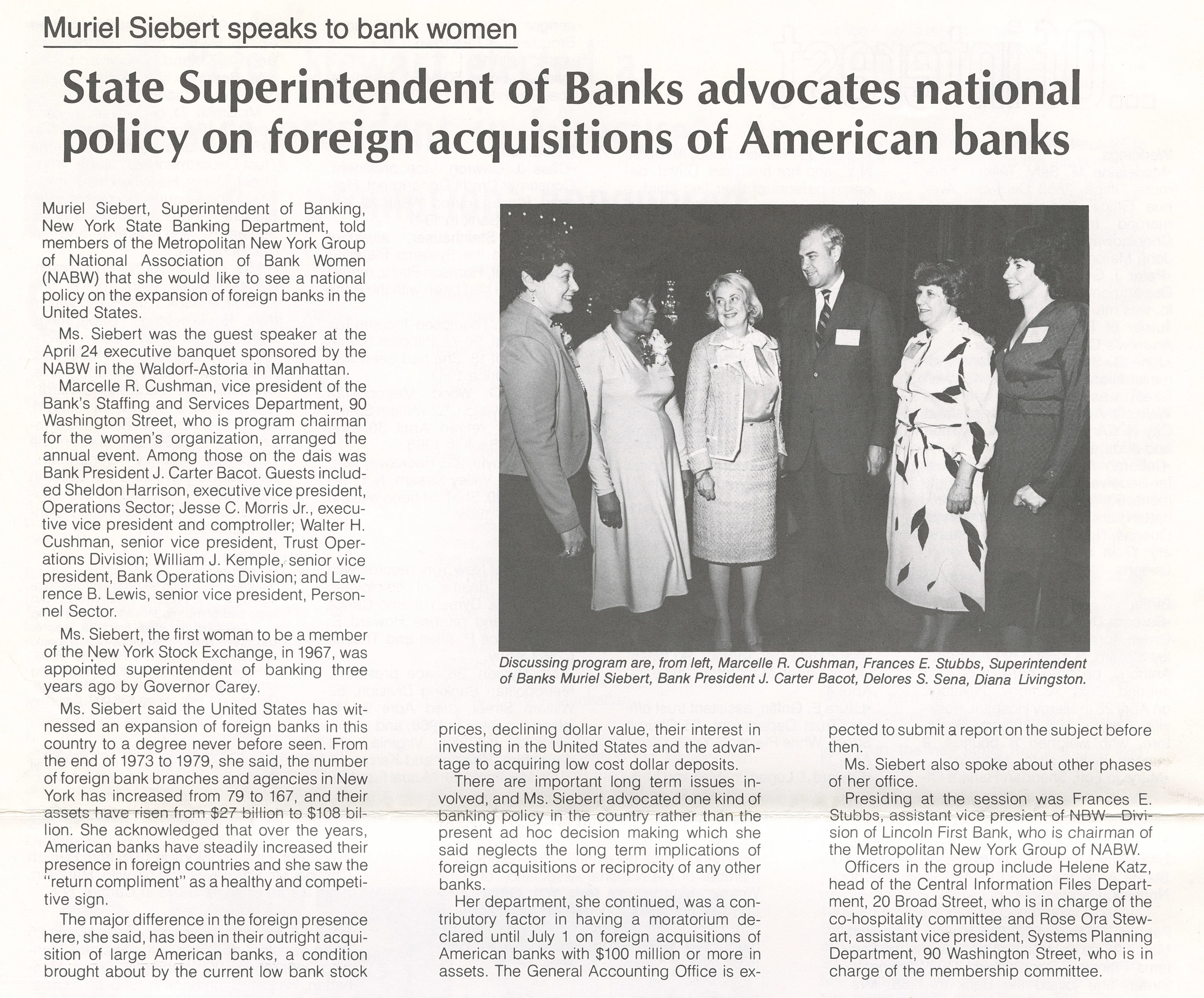
"State Superintendent of Banks Advocates National Policy," Bank One, The Bank of New York, April 1980. MSC, b. 155, f. 8.
Siebert oversaw approximately 500 banking institutions, $400 billion in assets, and $100 billion in trust accounts in banks in New York. She regulated state-licensed small loan companies, check cashiers, sales finance companies, and premium-finance agencies. Siebert also directed New York City’s Municipal Credit Union, Urban Development Corporation, and Job Development Authority. At a starting salary of $47,800 a year, Siebert worked seventy-hour weeks. When she received a raise in 1980 with other state officials, she sent a monthly check equal to her pay increase to the Widows and Orphans Fund of the Patrolmen’s Benevolent Association.
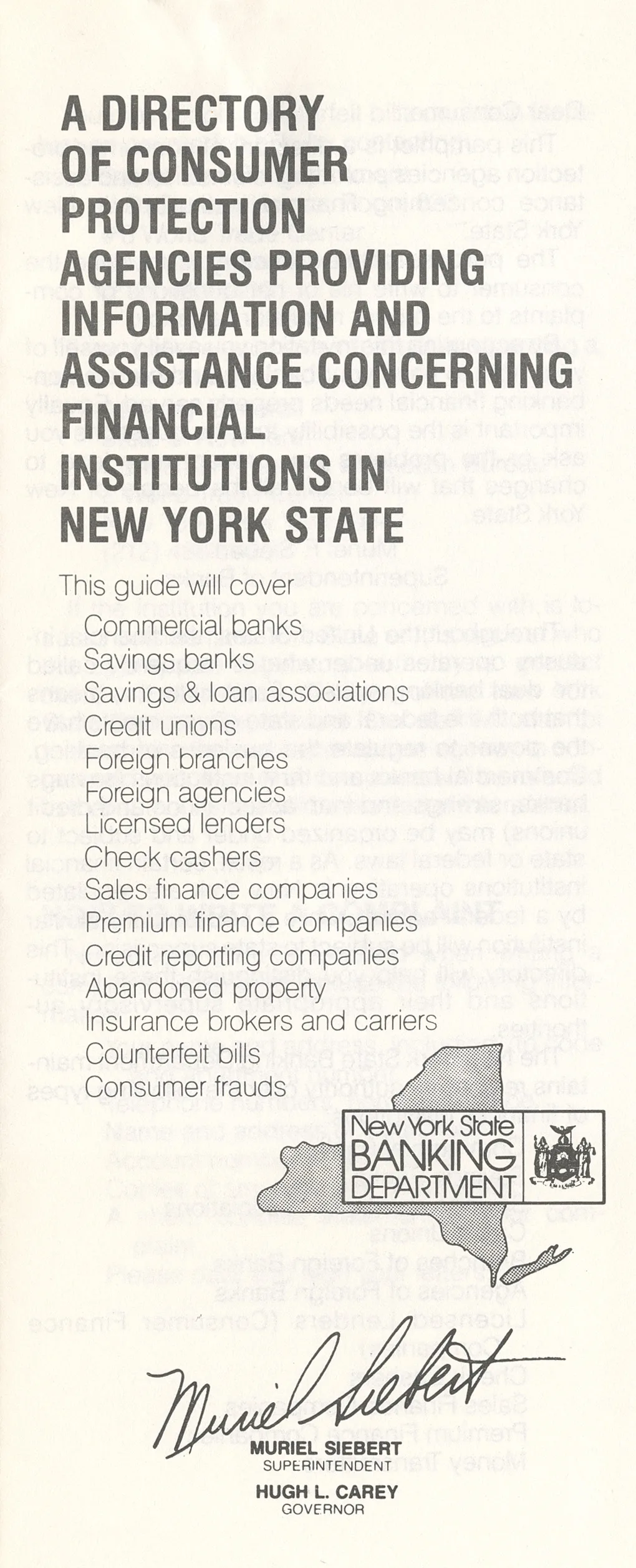
"A Directory of Consumer Protection Agencies," Muriel Siebert, Superintendent; Hugh L. Carey, Governor. MSC, b. 119, f. 5.
Responsible for the financial soundness of banking institutions, Siebert facilitated the merger of institutions with banks needing help. Of particular concern were faltering thrift institutions (savings banks, savings and loan institutions, and credit unions), upon which mortgages and the housing market relied. “My effort as superintendent was spent in arranging marriages between ailing and healthy banks,” Siebert wrote. “We established a mechanism and a standard for merging a diminished bank into a healthy one.”3 Not one New York bank failed while Siebert was superintendent. She helped avert the collapse of the Greenwich Savings Bank through the bank’s merger with the Metropolitan Savings Bank. Other mergers during her tenure included folding the Central Savings Bank into the Harlem Savings Bank and the Union Dime Savings Bank into the Buffalo Savings Bank.
While working as Superintendent of Banks, Siebert advocated for the establishment of a national policy to address the increasing number of foreign acquisitions of US banks. Governor Carey supported the acquisition of the Marine Midland Bank by the British-owned Hongkong & Shanghai Banking Co. (HSBC). Siebert, who questioned if a foreign bank would support the needs of New York State communities, wanted more data before she approved the application: “I was worried that the HSBC would not meet the needs of the local communities where Marine Midland was a unique institution, with the largest branch system upstate.”4 HSBC’s refusal to provide additional information put the merger on hold, yet Siebert stood her ground. The deal eventually went through, however, when the Marine Midland changed from a state to a national charter and received federal approval for the merger.
When the American Embassy in Iran was seized during the Iranian hostage crisis in 1979, the Iranian government announced it would withdraw its deposits from American banks. “Iranian banks had major credit lines with U.S. banks, and they could have wired all their assets out of the country, leaving us with only their liabilities,” Siebert said.5 In collaboration with the US Treasury Department, Siebert paid close attention to significant transfers of funds from four Iranian banks in New York State and oversaw payments of approved checks. “Under the arrangements, assets equivalent to 108 percent of the Iranian banks’ liabilities have been placed in accounts in New York banks that are in the name of the state banking department,” the New York Times reported. “No funds—will be allowed to be removed from these accounts without the approval and signature of Miss Siebert.”6 During the freeze on Iranian assets, Siebert also ensured funds would continue to be directed to Iranian students studying in the United States.
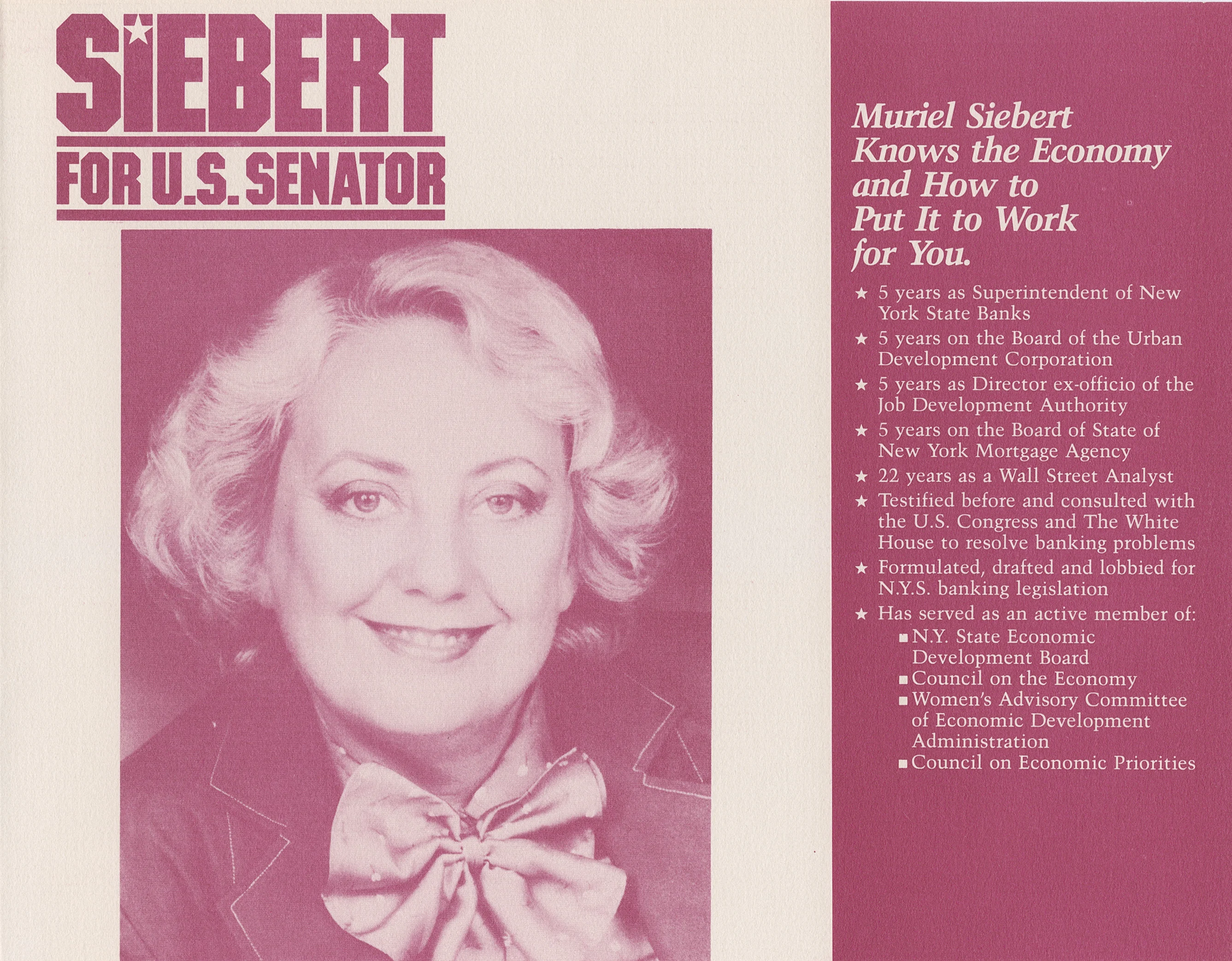
"Siebert for U.S. Senator." Campaign brochure, 1982. MSC, b. 132, f. 5.
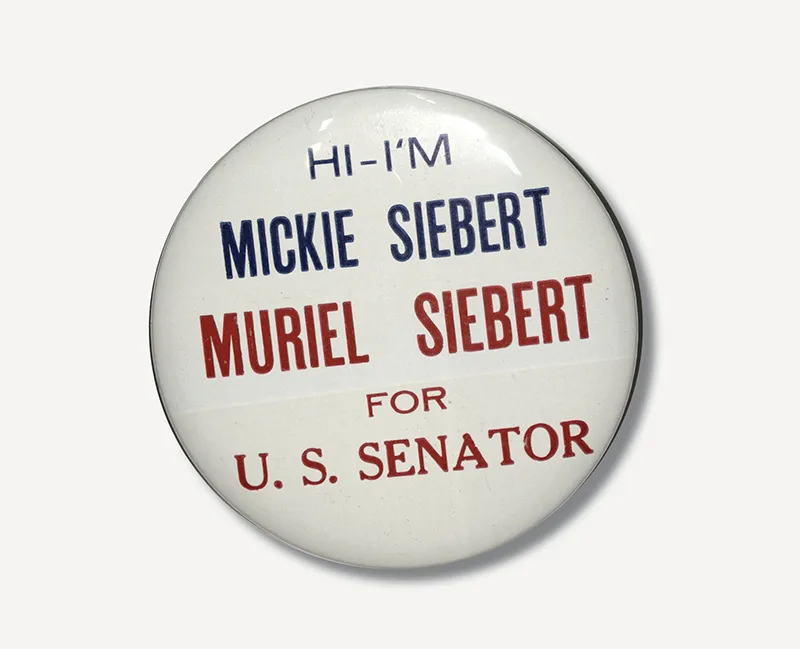
Siebert Senate campaign button, 1982. MSC, b. 68, f. 2.
Siebert’s role as Superintendent of Banks made her acutely aware of the need for financial reform and inspired her to run in the 1982 Republican primary for the New York Senate seat held by Democrat Daniel Patrick Moynihan. “My stint with the banking department convinced me that many financial laws needed changing,” she said.7 At the time only one other woman, Nancy Kassebaum of Kansas, held a seat in the US Senate. Siebert described herself as “fiscally conservative, strong on defense and tough on crime,” as well as pro-choice, a proponent of gun control, and “quite liberal in terms of people and human rights.”8 She spent $400,000 on the primary race and lost to Assemblywoman Florence M. Sullivan. Moynihan went on to win the Senate seat.
Siebert and Ball, Changing the Rules, 109.back to text ↑
Robert A. Bennett, "State Acts to Take Over the Assets of the Iran Bank Offices in New York," New York Times, November 17, 1979.back to text ↑
Siebert and Ball, Changing the Rules, 129.back to text ↑
Siebert and Ball, Changing the Rules, 128; Siebert in Frank Lynn, “Muriel Siebert Joins G.O.P Race for U.S. Senator,” New York Times, May 26, 1982. Siebert was a founder of the WISH List (Women in the Senate and House), a group formed in 1992 that supported pro-choice Republican women candidates.back to text ↑