Advocacy and Philanthropy
Photo: Muriel Siebert with Mayor Ed Koch, ca. 1985. MCS, b. 147. f. 5. Photograph by Holland Wemple, Photographer to the Mayor of the City of New York.
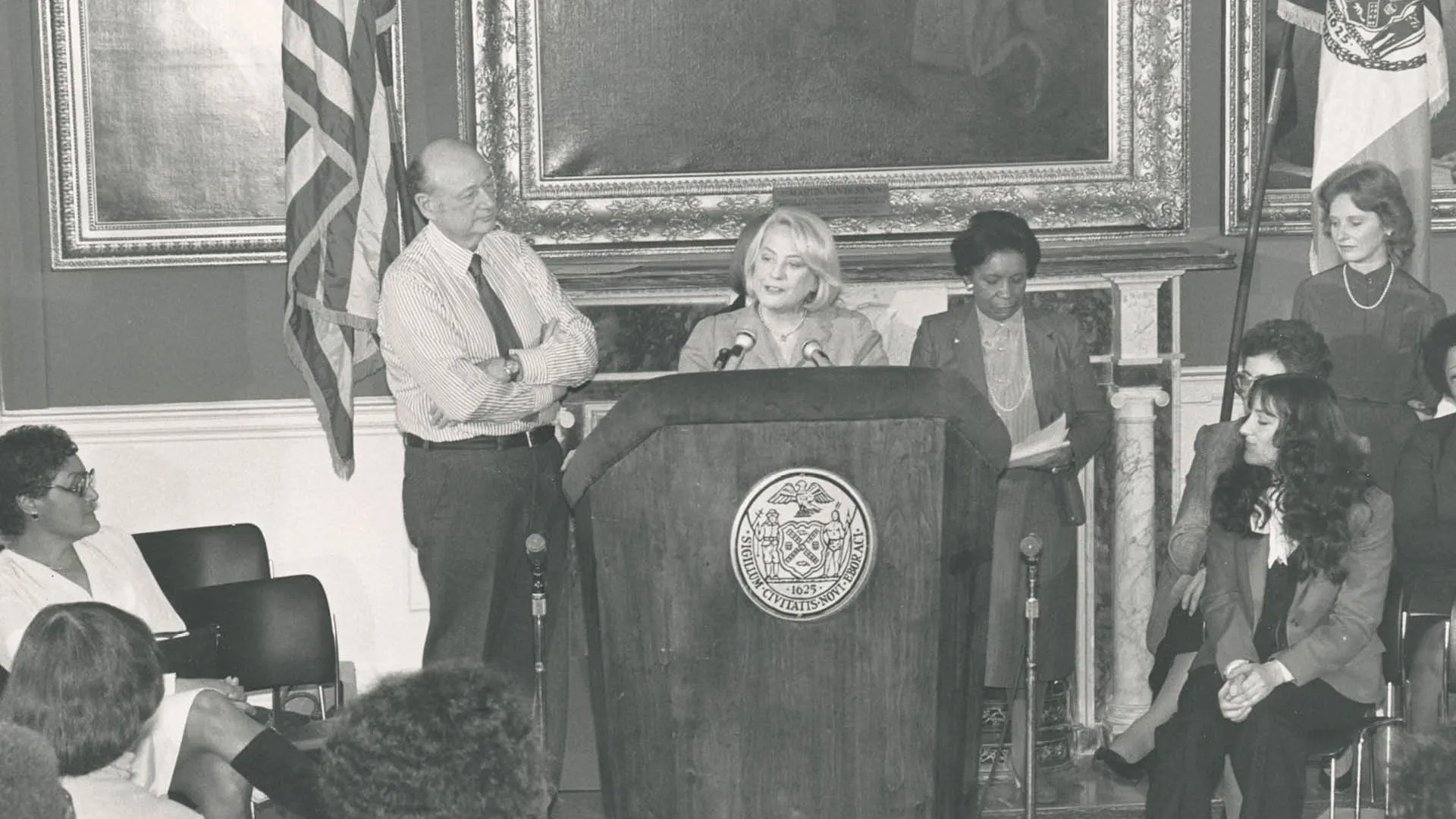
I’ve seen things I’ve wanted to do and I’ve done them. In some cases being a woman was an obstacle, but it probably gave me more incentives than I would have had if I’d been a man.(1)
—Muriel Siebert
Mentors for women didn’t exist when I started on Wall Street,” Muriel Siebert wrote. “Men were the hirers and firers, the promoters and demoters; a woman’s presence was tolerated rather than championed.”(2) Women working their way up from research analysts to traders, brokers, and partners found themselves in a business culture characterized by lower pay, fewer opportunities for career advancement, and potential sexual harassment. “I got paid about 60% of what the men got,” Siebert said.(3) “It makes you a feminist when you’re making $150 a week and the man sitting next to you is making $300.”(4) In 1974, Siebert became a founder of the Women’s Forum and in 1982 of the Committee of 200, organizations supporting women in business.
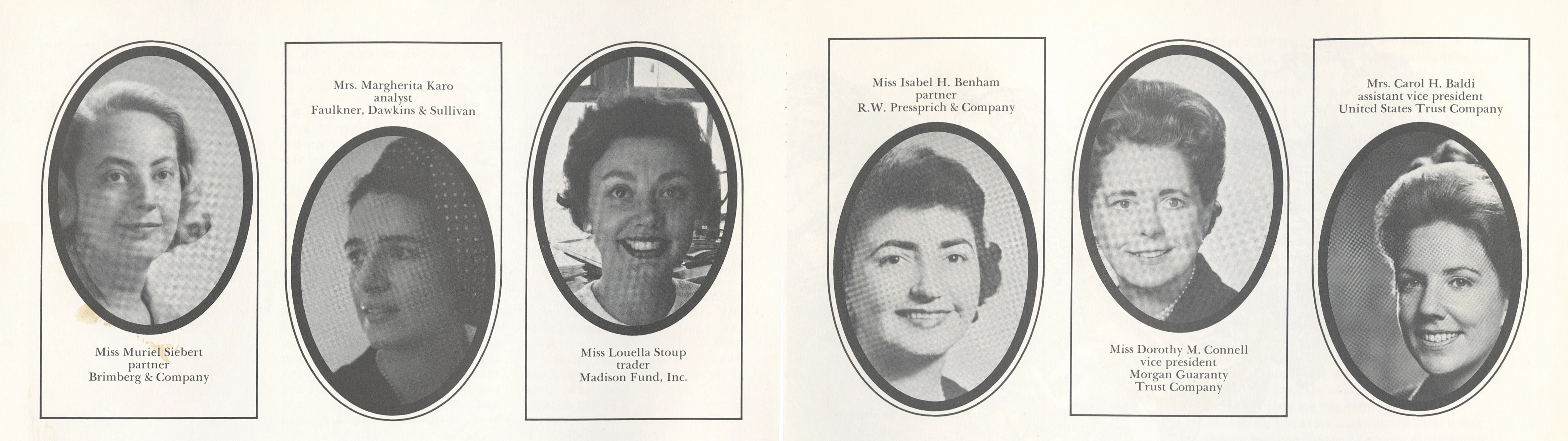
"Ladies on the Street," The Institutional Investor, November 1967. MSC, b. 130, f. 7.
Siebert encountered gender discrimination on many fronts. When she arrived at the men’s Union League Club to attend a board meeting, she discovered club rules denied women access to the elevator. She could only enter the dining room via the kitchen and back stairs. At the NYSE Luncheon Club, located on the seventh floor, she found there was no access to a women’s restroom. Siebert threatened to have a portable toilet delivered if one was not installed. In 1987 (twenty years after Siebert bought a seat on the Exchange), a women’s lavatory was built.
Professional meetings often took place in all-male social clubs in New York, cutting women off from critical business activities. Siebert testified on behalf of a bill forbidding business to take place in clubs that restricted membership, and New York City Mayor Ed Koch signed legislation in the early 1980s that prohibited business activities in clubs participating in discriminatory practices.
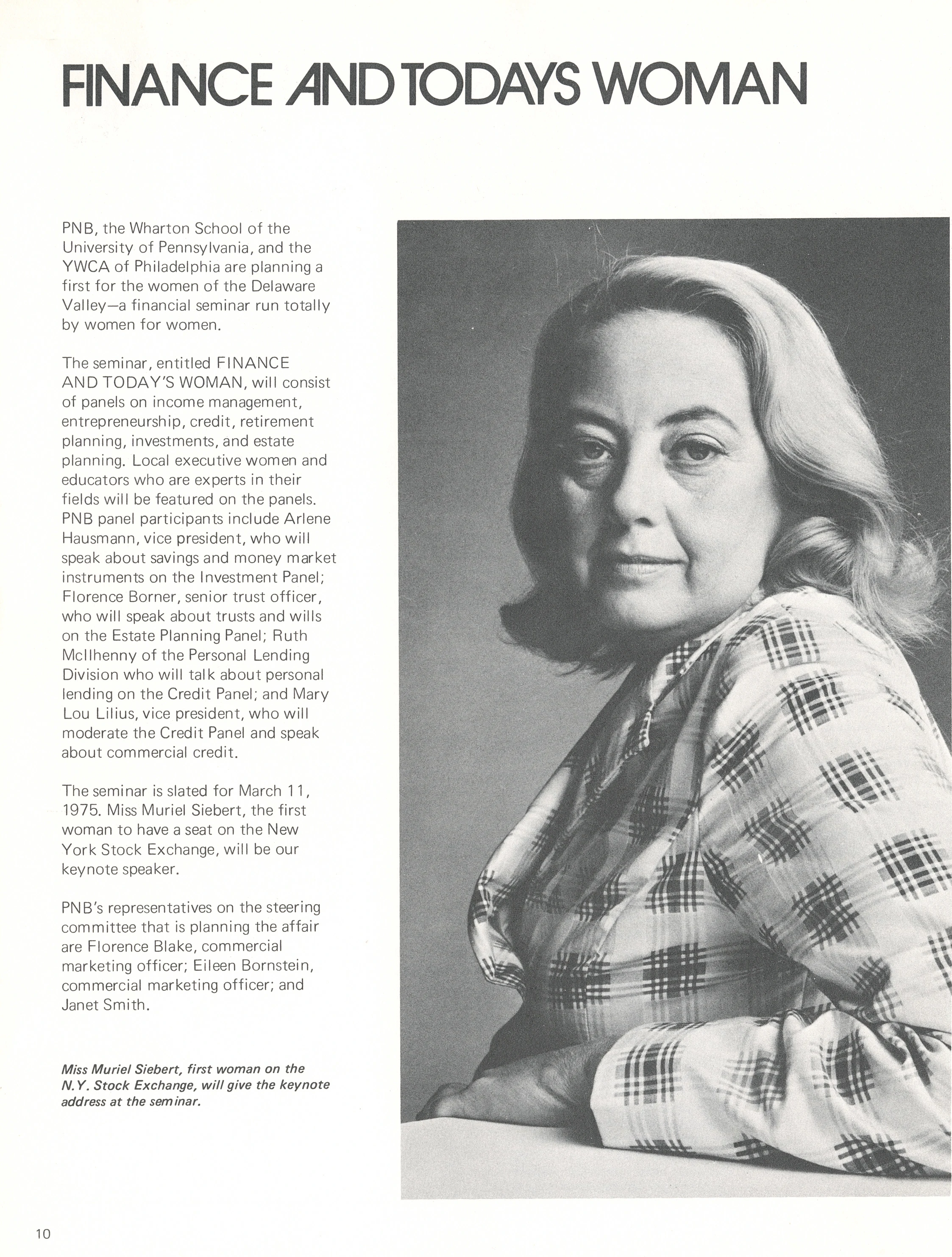
"Finance and Today’s Women." Announcement, December 1974. MSC, b. 17, f. 6.
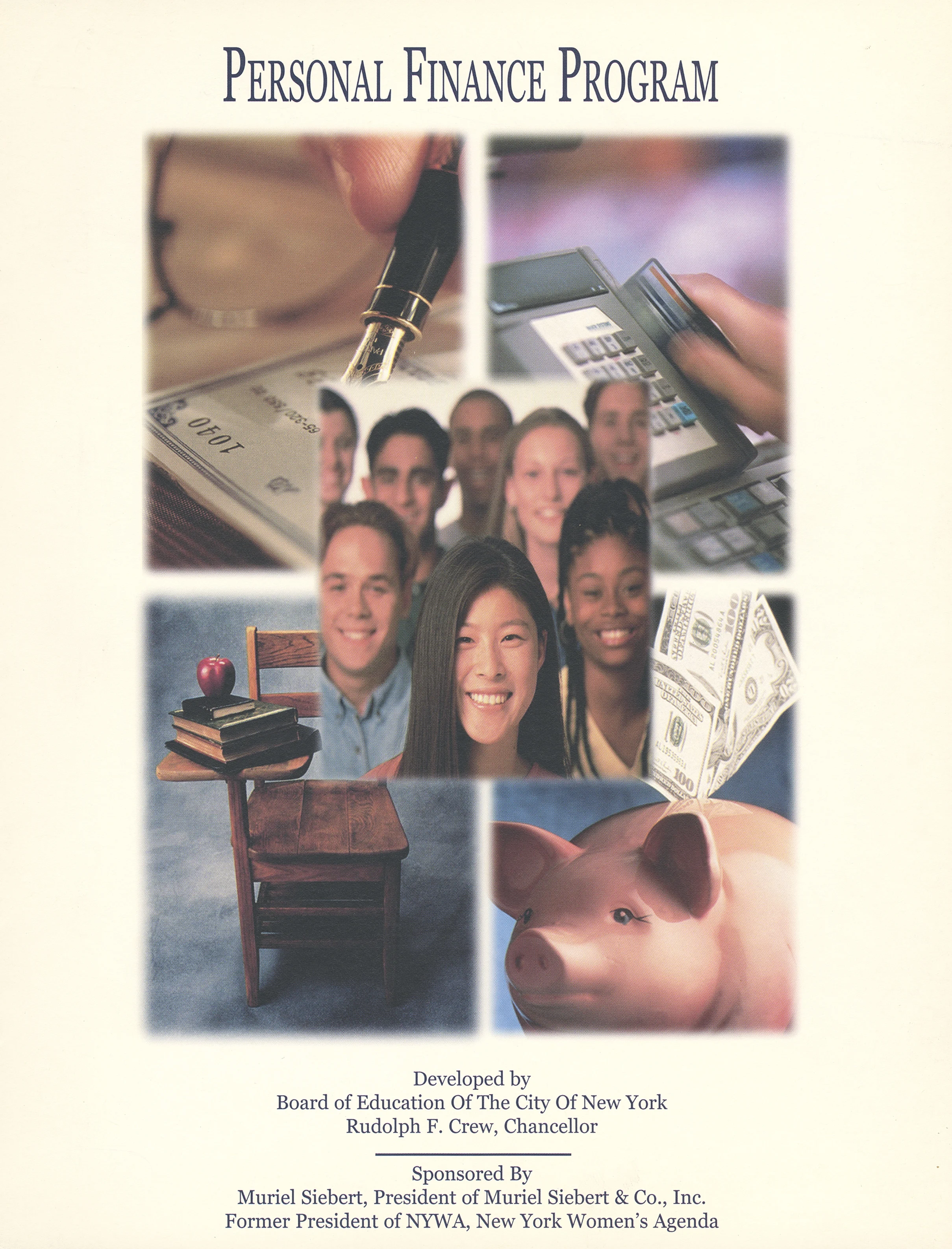
"Personal Finance Program, Developed by the Board of Education of the City of New York." MSC, b. 102, f. 5.
When she started out on Wall Street, Mickie Siebert observed that many of her female clients knew little about personal finance. A survey she sponsored in 1968 of four-year women’s colleges revealed that many graduates had never taken a course in managing money.(5) “The institutions of higher learning in this country seemed to have agreed that it was more important to know how to dissect a frog than how to manage personal finances,” she wrote.(6) “College has failed to allow girls to equip themselves for a business career. More importantly, they are totally lacking in basic principles of personal money management. . . . Eventually they find themselves as widows called upon to administer and manage estates for which they are totally unprepared. Or they get jobs and have money to invest and do not have any basic preparation.”(7)
Siebert’s criteria of basic financial knowledge included mortgages, pension plans, employee profit sharing plans, Social Security, savings accounts, and other investments. She spoke about financial literacy at colleges, in investment group seminars, and on television. When Siebert became president of the New York Women’s Agenda in 1998, she broadened her advocacy of financial literacy to include high school students.“I found out we do not teach younger people in schools personal financial literacy,” Siebert said.(8) She helped establish the “Siebert Personal Finance Program,” a twenty-one-lesson curriculum covering checking accounts, credit cards, taxes, and financial planning. Adopted by the New York City Department of Education, the course would expand to reach middle and high school students in other states as well.
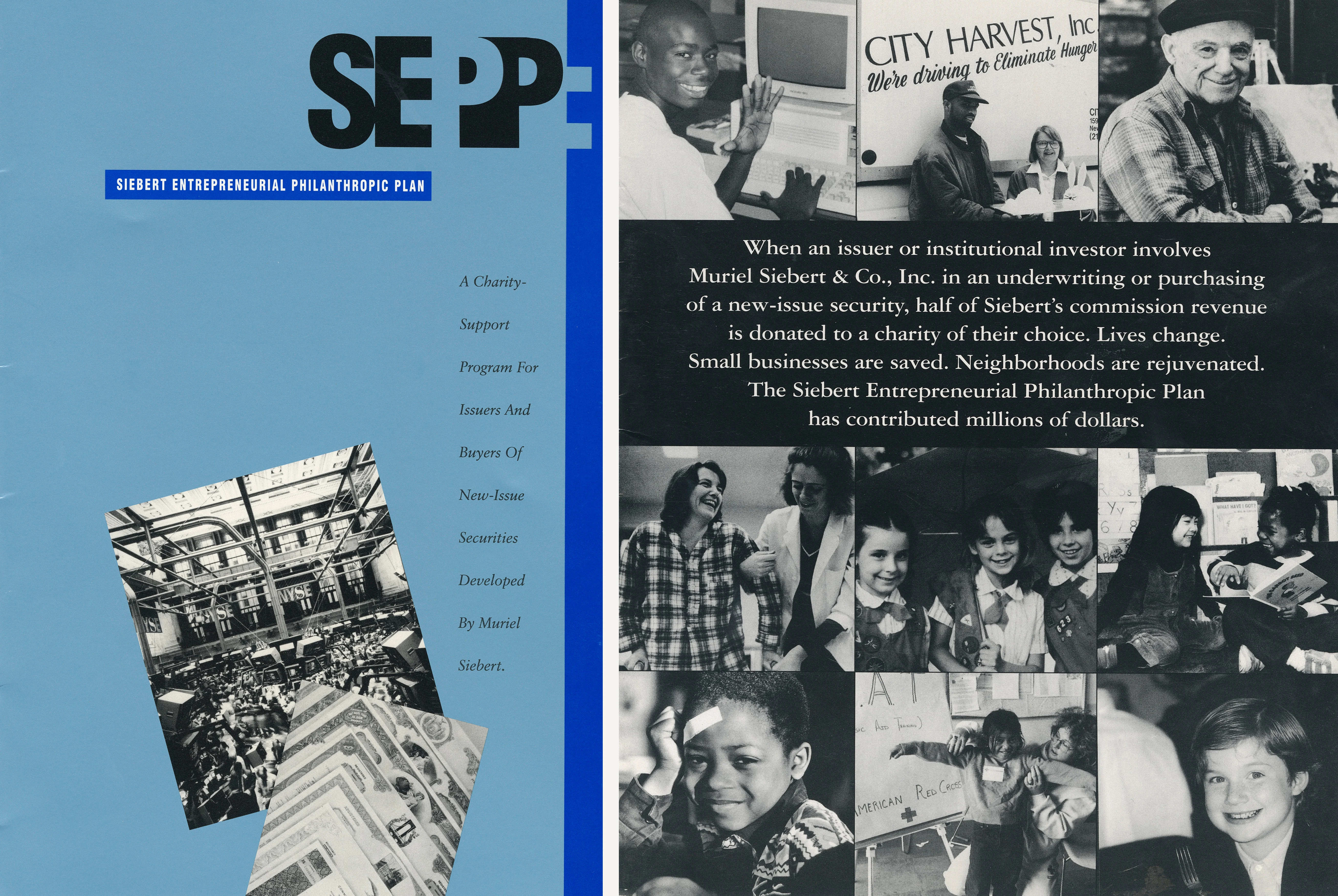
Siebert Entrepreneurial Philanthropic Plan brochure. MSC, b. 180, f. 2.
As Siebert achieved success on Wall Street, she wove philanthropic endeavors into her work. “Giving back is more than an obligation, it’s a privilege,” she said.(9) In 1990, she established the Siebert Entrepreneurial Philanthropic Plan (SEPP). “I was raised to believe that when good things happen, you owe. . . . And it’s a good feeling for me to realize that I am able to put together my brain, my heart, and my knowledge to create something like this.”(10)
SEPP directed to charity 50 percent of profits (after clearing costs) from the fees associated with the firm’s underwriting or purchasing of new securities. Issuers or buyers of the securities could select charities serving areas where securities were bought or sold, thereby lending support to local communities in need. “We are doing this because I realize my firm is being given the opportunity to participate in these underwritings because we are classified as a woman-owned business enterprise,” she explained.(11) The social impact of Siebert’s philanthropy was felt widely. Organizations around the country—whether small businesses owned by women, food rescue initiatives, homelessness and domestic violence support, daycare centers for the elderly, or inner-city youth programs—received assistance through the SEPP program.
Lynn Gilbert and Gaylen More, Particular Passions: Talks with Women Who Have Shaped Our Times (New York: C. N. Potter, 1981), 235.
Siebert and Ball, Changing the Rules, 201.
"Muriel Siebert," Makers, 9.
"Meet New York’s Top Financier," Albany Times Union, March 21, 1982. Muriel Siebert Collection, Box 134, Folder 6.
Carol Kocivar, "Finds Colleges Fail to Teach Money Handling," Reporter Dispatch, White Plains, NY, October 30, 1968. Muriel Siebert Collection, Box 88, Folder 11.
Siebert and Ball, Changing the Rules, 42.
Kocivar, "Finds Colleges Fail to Teach Money Handling."
"Muriel Siebert," Makers, 33.
Siebert and Ball, Changing the Rules, 203.
Elizabeth Greene, "N.Y. Stock Exchange’s First Woman Uses Profits to Underwrite Charities," Chronicle of Philanthropy, June 16, 1992. Muriel Siebert Collection, Box 133, Folder 6.
Van Dyk, "I’ve Never Pounded the Door as a Woman," 19.