There are three four-letter words ending in k that are responsible for my success. One is work. . . . The second is luck. . . . The third . . . is risk.(1)
—Muriel Siebert
In the mid-1990s, after four decades on Wall Street, Muriel Siebert reflected on the influences that shaped the trajectory of her career: “I think early on I saw my mother’s frustration. She had this wonderful singing voice, but in those days nice Jewish girls didn’t do anything about a career. I think her frustration, which she took to her grave, made me a rebel, although I didn’t realize it at the time.”(2) As she achieved success, Siebert appreciated that “On Wall Street, I had days where I made more money . . . in one day than my father made all year. . . . And I think there is an obligation that when you make that kind of money, you should give back.”(3)
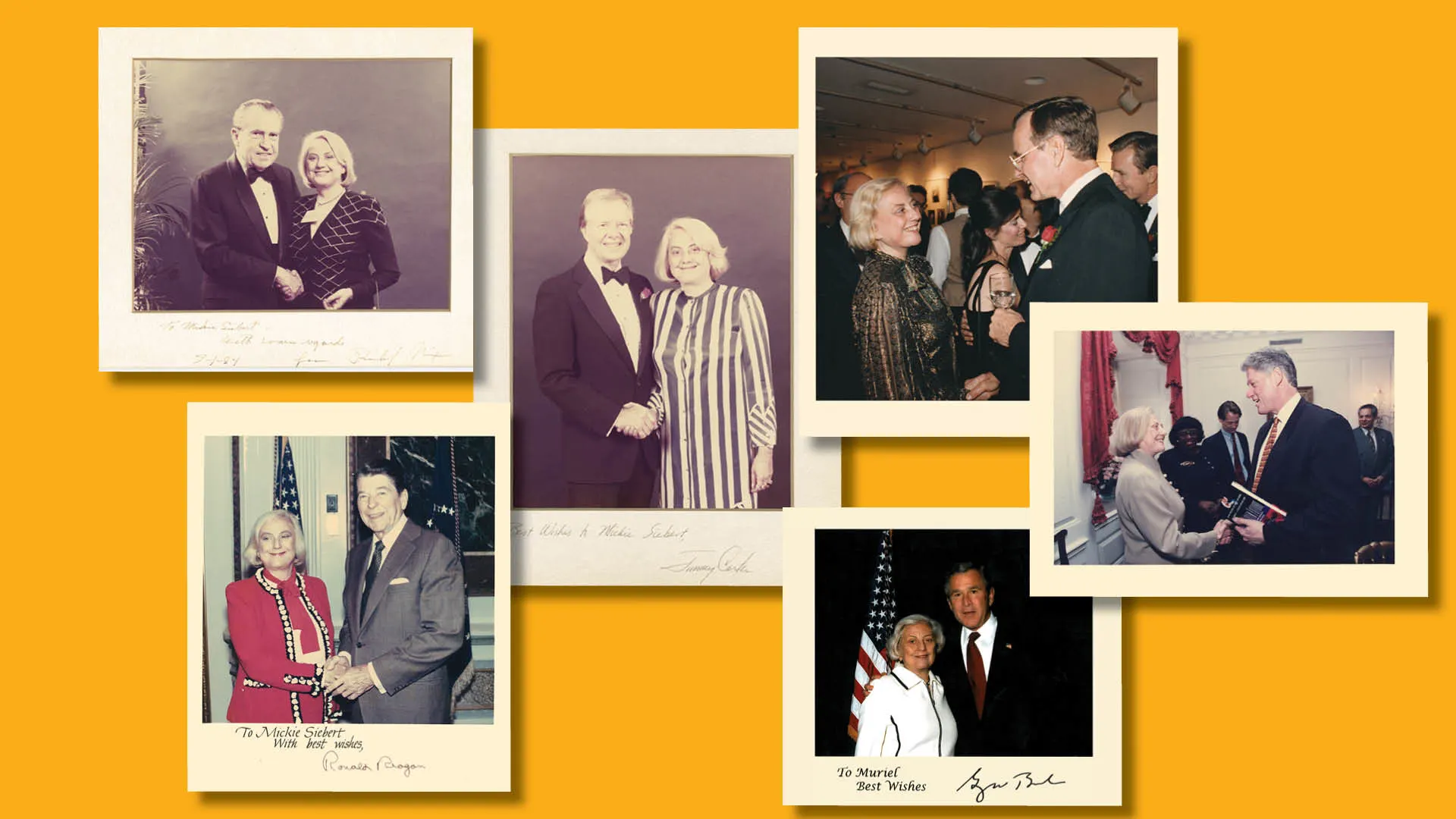
Among Siebert’s many accolades were her induction into the National Women’s Hall of Fame and the International Women’s Forum Hall of Fame. She received numerous honorary degrees and was a visiting professor and guest lecturer at Harvard Business School, Wharton Graduate School of Business, Dartmouth College, and New York University School of Commerce, among others.(4) As an owner of a brokerage firm and Superintendent of Banks in the State of New York, Siebert spoke before Congress and at the White House on issues relating to banking regulation and the role of women in finance. She received recognition from Presidents Richard Nixon, Jimmy Carter, Ronald Reagan, George H. W. Bush, Bill Clinton, and George W. Bush for her groundbreaking contributions to the financial industry in the public and private sectors.(5)
On January 5, 1998, Siebert rang the closing bell of the NYSE to commemorate the thirtieth anniversary of her membership in the Exchange. She rang it on December 21, 1999, to mark the millennium, and again on December 28, 2007, in recognition of her fortieth anniversary as a NYSE member. Mickie continued her business, civic, and philanthropic work into her eighties. In 2016, three years after her death, the NYSE opened Siebert Hall, the first and only room in the Exchange dedicated to an individual. Muriel Siebert & Co., Inc., continues today as a subsidiary of the Siebert Financial Corporation.
Muriel Siebert took “her position as a patron of women’s causes seriously. But for her, this role was not initially a conscious choice, but rather the inevitable outcome of her drive to succeed in her chosen profession—a business she loved,” Sue Herera writes in Women of the Street.(6) “I feel the obligation to slug it out for my gender,” Siebert said. “In both the corporate world and as founders and owners of companies, women have been strong partners in building the American Dream. They have created nothing short of a silent revolution in our country’s business life.”(7) With characteristic resolve both to succeed and to empower others, Siebert defied the gender inequities of her time as she helped shape a transformative period for women in business.
Siebert and Ball, Changing the Rules, 181.
Linda Drogin, "The Wizard of Wall Street," The Reporter, Women’s American ORT, vol. 44, no. 4 (Winter 1994/95), 6. Muriel Siebert Collection, Box 135, Folder 1.
"Interview with Muriel Siebert," Crimson & Brown Associates 3, no. 1 (1997), 46. Muriel Siebert Collection, Box 136, Folder 9. Upon her death in 2013, Siebert also left charitable donations on behalf of financial literacy and the humane treatment of animals, particularly those owned by elderly persons who were financially challenged.
Siebert served on the boards of the Metropolitan Museum of Art, the Greater New York Council of Boy Scouts of America, and the New York State Business Council.
Siebert received the White House Conference on Small Business Award for Entrepreneurial Excellence from Ronald Reagan in 1986.
Herera, Women of the Street, 84.
Siebert and Ball, Changing the Rules, 199.