Muriel Siebert rose to partner at smaller brokerage firms but continued to make less than her male colleagues. “I was doing a very large institutional business, and I wanted to go to another firm so I would get more credit for my accounts.”2 One of her clients, Gerald Tsai Jr., a fund manager, suggested that she instead buy a seat on the NYSE and start her own firm. Siebert found no rules in the NYSE constitution preventing a woman from buying a seat: “It said that you had to have a business reason, you had to be over 21 and had to be able to finance your seat.”3
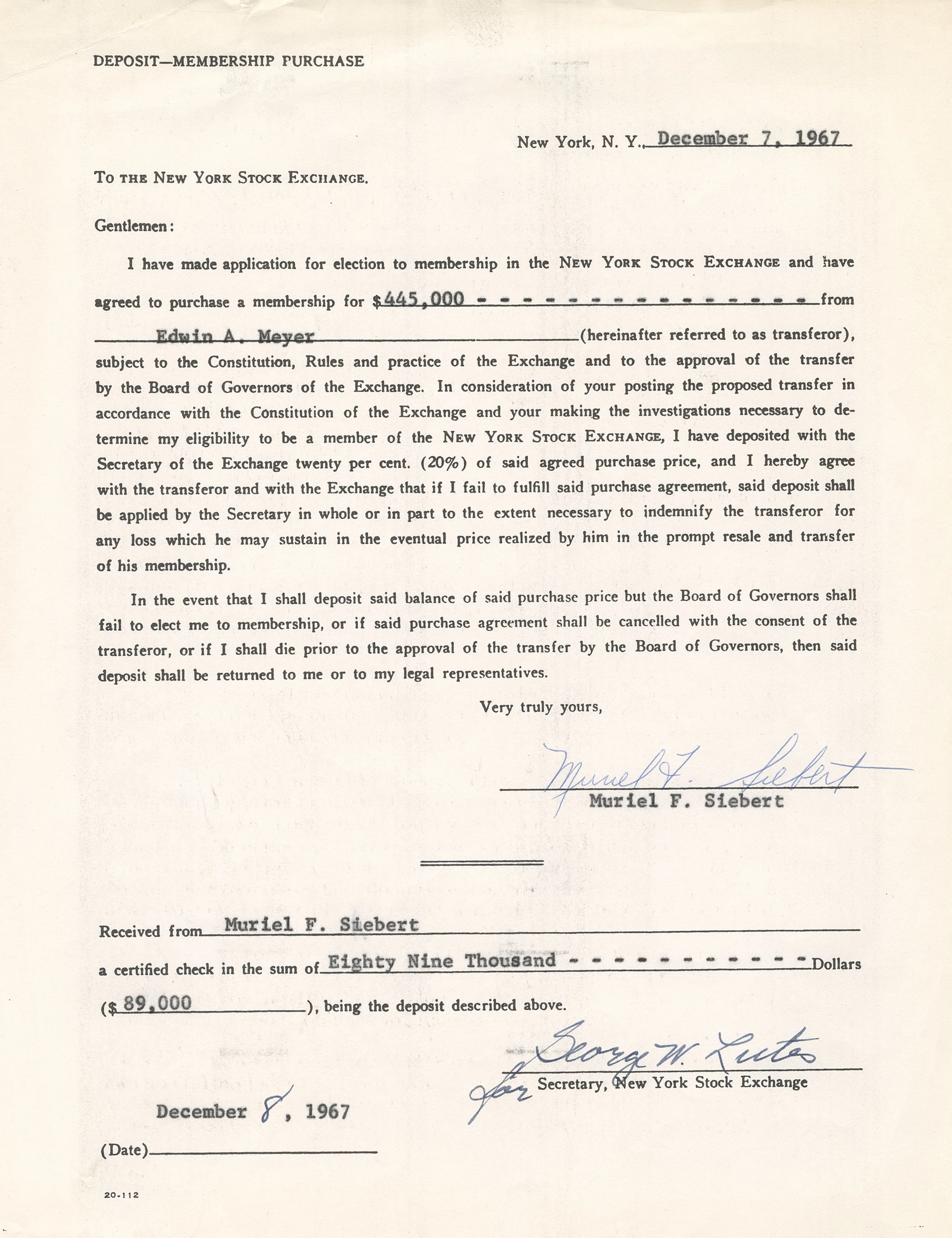
Deposit, membership purchase for New York Stock Exchange for Muriel F. Siebert, December 7, 1967. MSC, b. 79, f. 1.
Established in 1792, the New York Stock Exchange, also known as the Big Board, is the oldest stock exchange in the country and the largest stock exchange in the world. “When I applied for a seat on the exchange, there was an uproar. Some people who felt that women should not be admitted to the stock exchange came to me and said so. But for every one person who resented my action, I found there were others who were happy for me. . . . I did a lot of soul-searching and talked to some of my other clients and I worked up enough strength to approach the exchange.”4
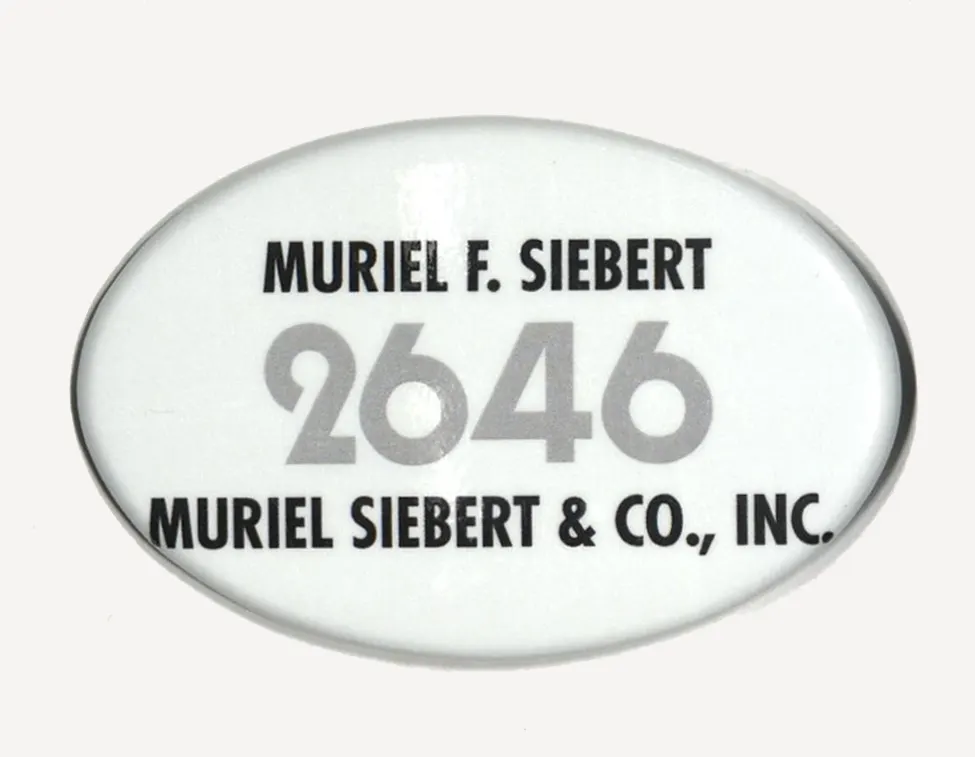
A seat on the NYSE cost Siebert $445,000 (the equivalent of more than $4 million today). Siebert put down 20 percent, and the Exchange stipulated she obtain a loan, something it had not required of other applicants. Siebert described the Catch-22 she faced: “There would be no loan until I was accepted, and I couldn’t be accepted without the loan.”5 Eventually, she was able to secure a loan of $300,000 from Chase Manhattan Bank. She described her membership badge as “the most expensive piece of jewelry going."6
After nine attempts, Siebert found two men to sponsor her for the seat: Ken Ward, a research partner at Hayden Stone, and Jim O’Brien, a partner at Salomon Brothers and Hutzler. O’Brien recalled that Siebert “worked hard to establish herself in this field as an expert. What more can you ask of a person? It is true that many of the male members didn’t want a woman on board. . . . Having a woman around would change the masculine ambience of the club.”7
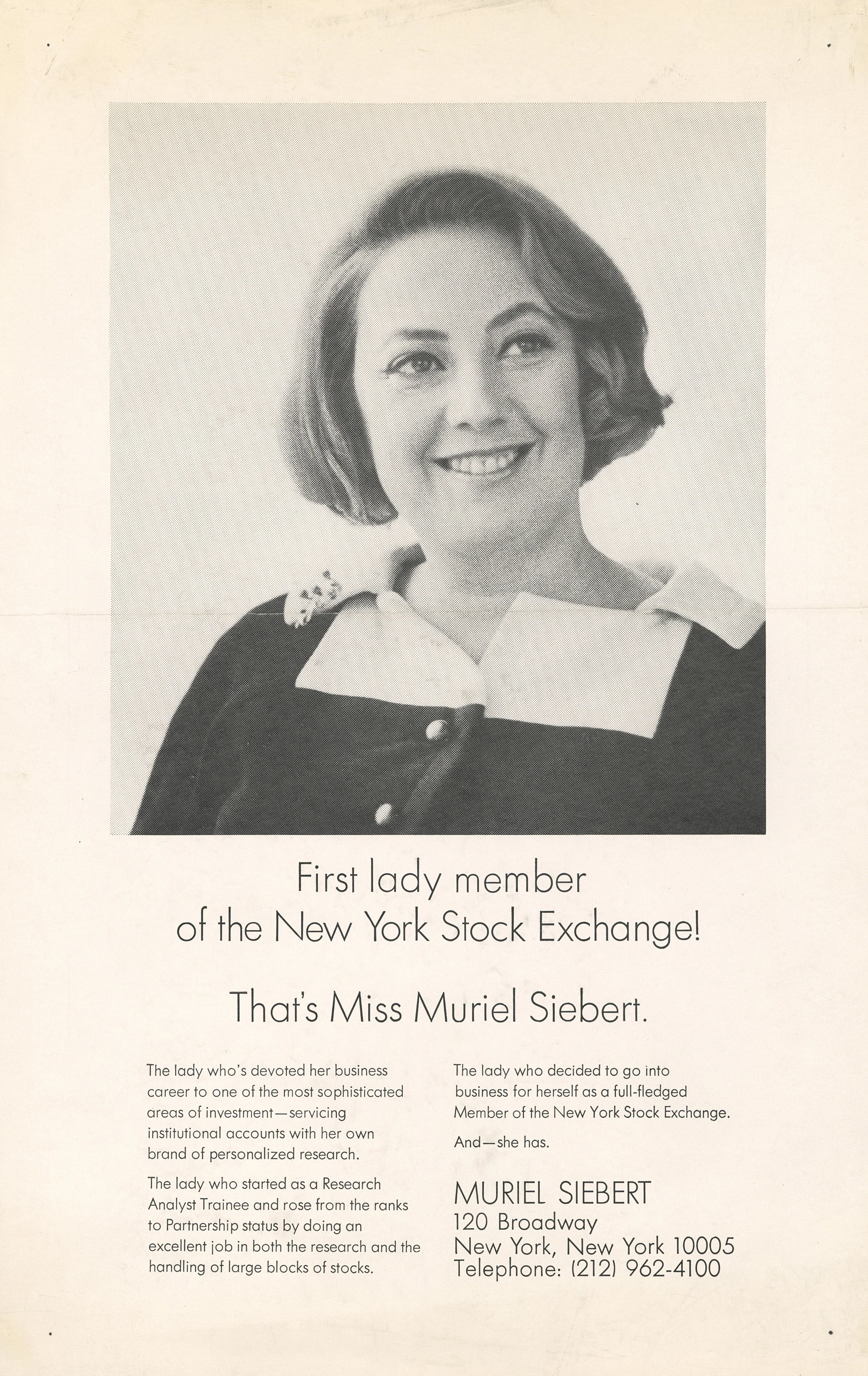
“First Lady Member of the New York Stock Exchange!” Advertisement, Muriel Siebert, MSC, b. 90, f. 1.
The draft of the announcement, created by an ad agency Siebert hired to publicize her membership, referred to her as “First Lady of the New York Stock Exchange.” Upon review by the chairman of the Exchange, who maintained that his wife was the first lady, the copy was changed to “First Lady Member of the New York Stock Exchange.” While the press recognized Siebert’s abilities as an analyst, it also made frequent references to her physical appearance, age, and single marital status—not the coverage typically received by her male colleagues.8
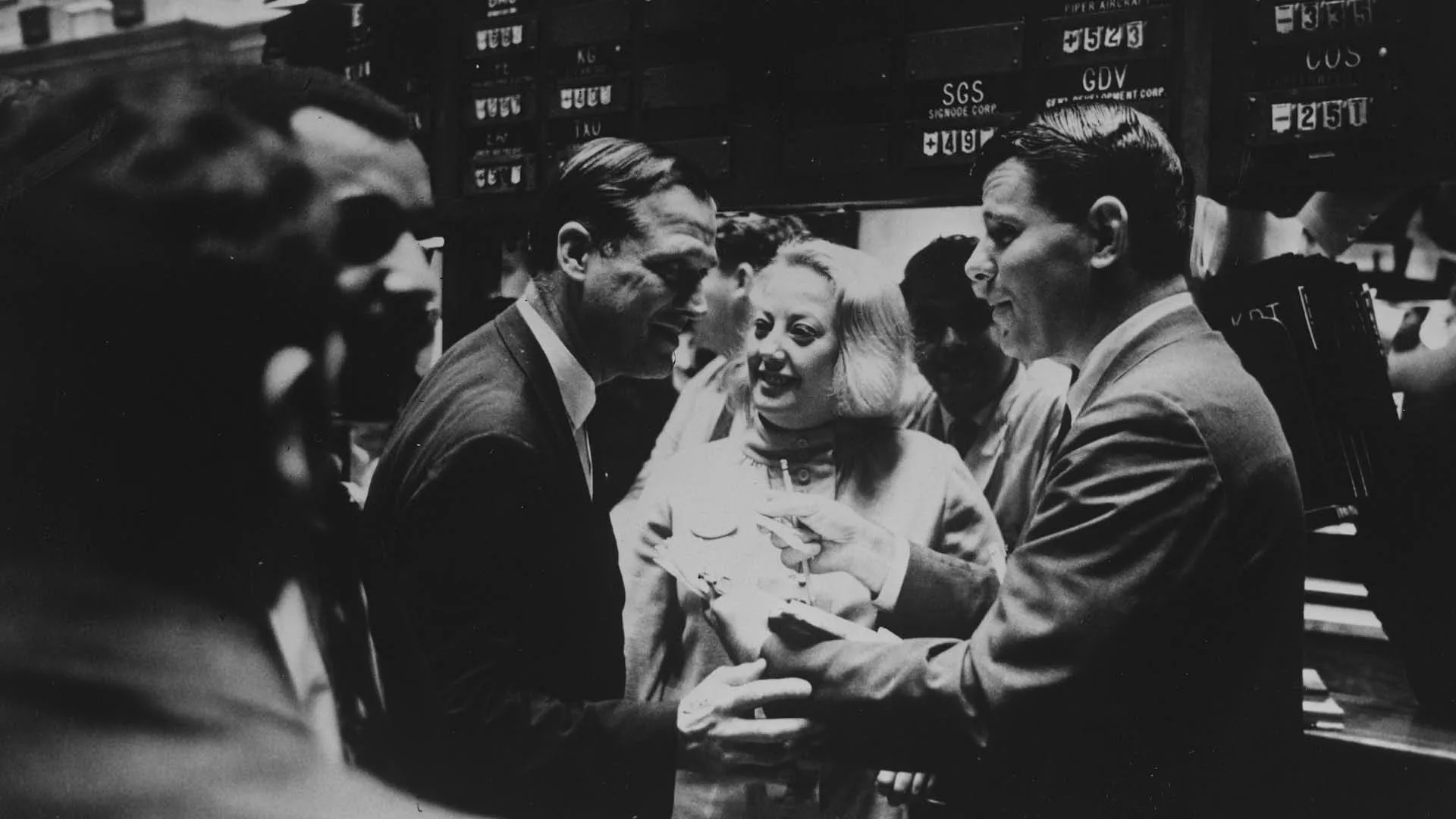
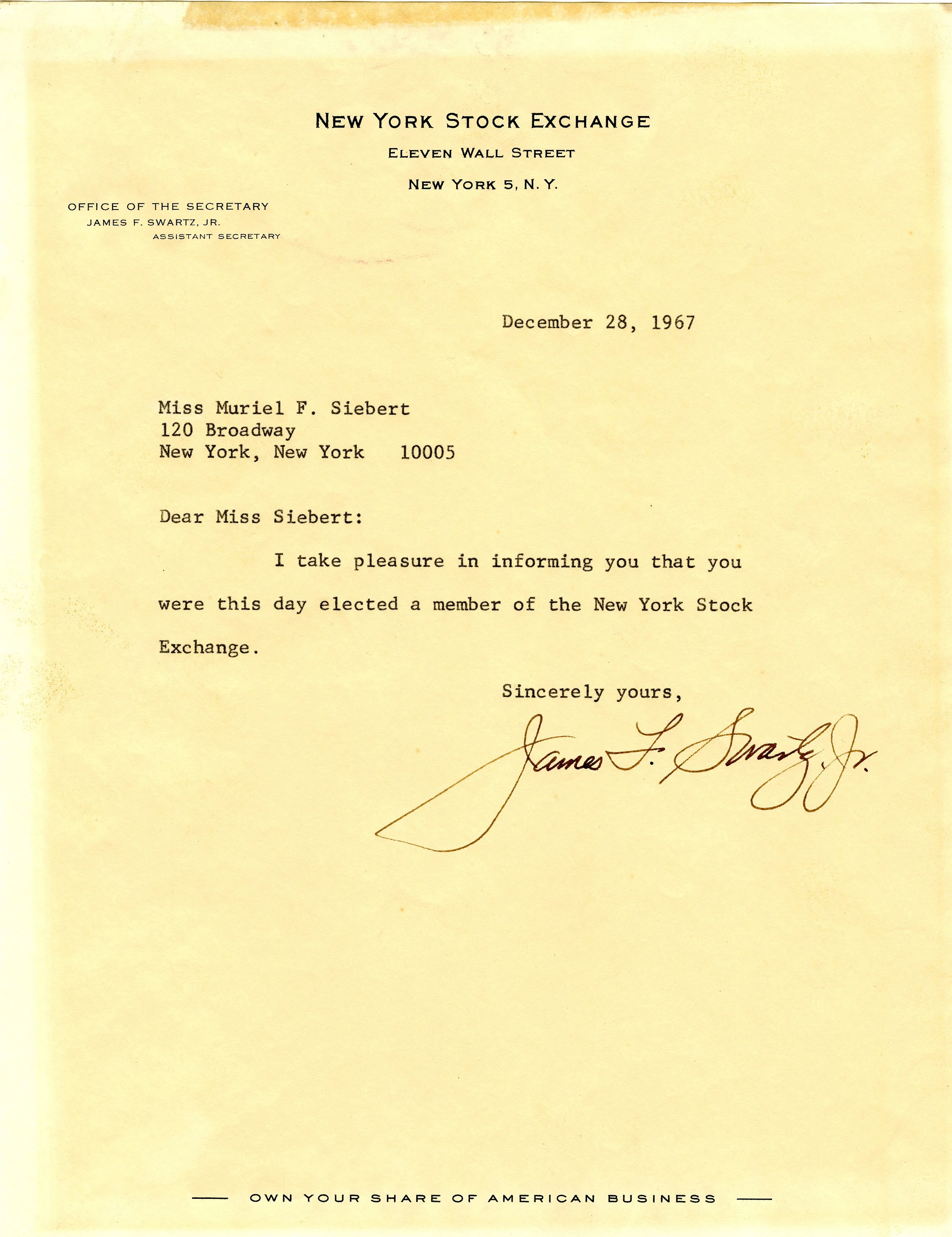
On December 28, 1967, Siebert became the first woman to hold a seat in the 175-year history of the Exchange—the only woman among 1,365 men. She observed: “Some of the men thought a woman had no place on the floor of the New York Stock Exchange, and yet there were men who went over backwards to be nice [’]cause they saw I was serious and I was doing the job.”9 It was not until 1976, nine years later, that Alice Jarcho, who began as a clerk on Wall Street for Hirsch & Co., became the second full-time woman broker on the Exchange.10
Letter from James F. Swartz Jr. to Muriel F. Siebert confirming her membership in the New York Stock Exchange, December 28, 1967. MSC, b. 79, f. 1.
“Wall Street was not new to the idea of keeping certain people out,” Paulina Bren writes. “Investment bankers were largely based on kin and contacts: the right school, the right background, and then a tap on the shoulder inviting you to join the other gentlemen on Wall Street.”11 While the number of women earning MBAs was growing, female MBA graduates nonetheless encountered discriminatory hiring practices and sexism in the fields of finance and business. Without the benefit of a college degree or an MBA, Siebert began earning recognition as a trailblazer. She appeared in the 1969 publication New Breed on Wall Street: The Young Men Who Make the Money Go—the only woman featured among sixty-two Wall Street brokers.12
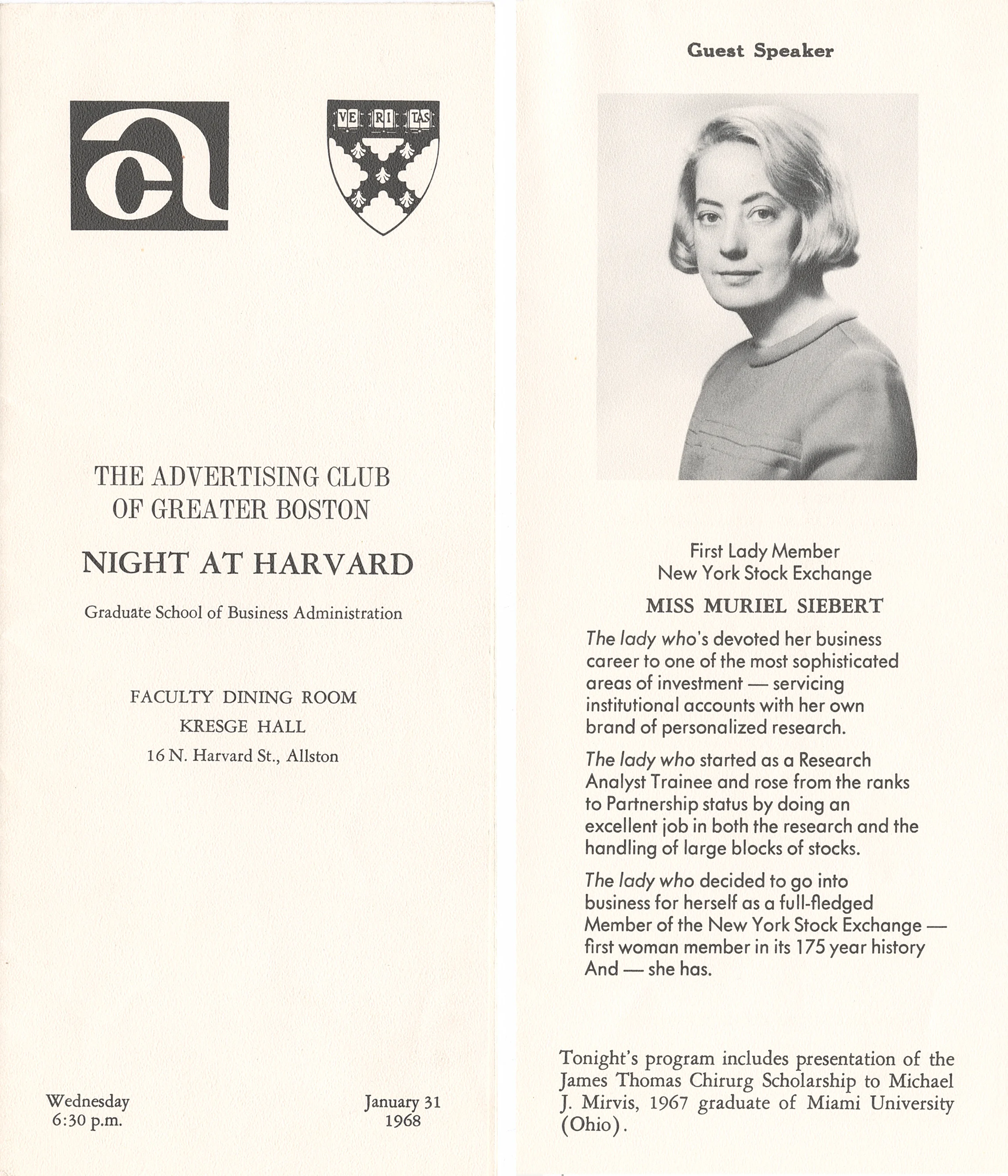
"The Advertising Club of Greater Boston, Night at Harvard, January 31, 1968." Program brochure. MSC, b. 13, f. 18.
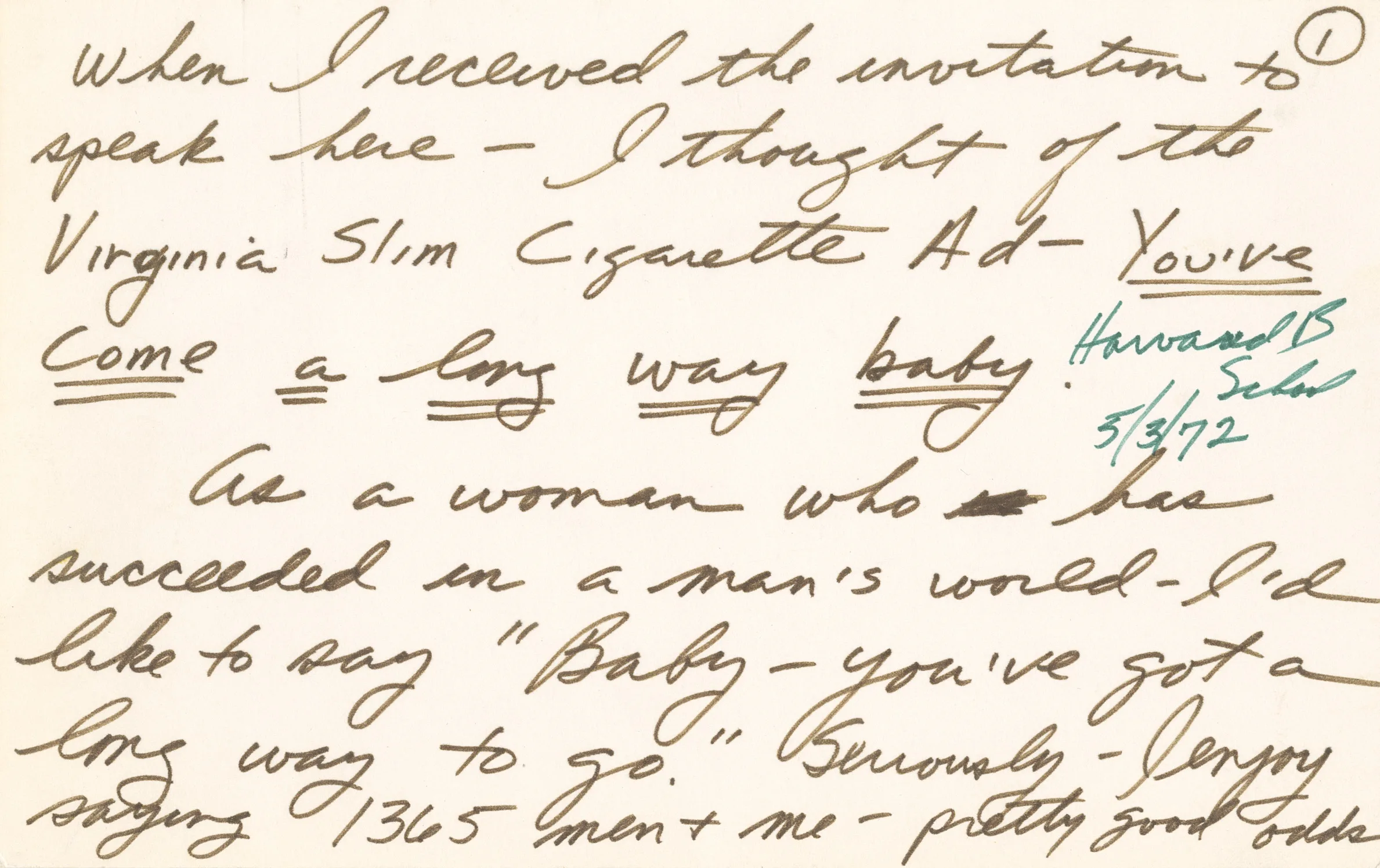
In 1968, shortly after Siebert brought her seat on the Exchange, she spoke at Harvard Business School (HBS).13 HBS had admitted eight women into its full MBA program five years earlier. In 1972, HBS Dean Lawrence Fouraker invited Siebert to be keynote speaker for a program on “The Impact of Women on Today’s Business Environment.” The event had been recommended by first-year women MBA students and organized by a committee of male and female students working with faculty. “Such a day was first suggested by the women . . . as a vehicle for raising the consciousness level of their male counterparts in a variety of areas loosely related to the subject of women in management," Fouraker wrote in his invitation to Siebert.14 Siebert began her address: "When I received the invitation to speak here—I thought of the Virginia Slim Cigarette Ad—You’ve come a long way baby. As a woman who has succeeded in a man’s world—I’d like to say 'Baby—you’ve got a long way to go.'"15
Notes for keynote speech by Muriel Siebert for "Women in Management Day Program," Harvard Business School, May 3, 1972. MSC, b. 16, f. 6.
"Muriel 'Mickey' [sic] Siebert: A Profile in Daring," Option News, February 20, 1984. Muriel Siebert Collection, Box 132, Folder 3.back to text ↑
Jere Van Dyk, "I’ve Never Pounded the Door as a Woman," Profit (September/October 1992), 18. Muriel Siebert Collection, Box 133, Folder 7.back to text ↑
George J. Barmann, "Cleveland’s Mickie a Match for Men on Wall Street," The Plain Dealer, Cleveland, May 30, 1971. Muriel Siebert Collection, Box 155, Folder 6.back to text ↑
Enid Nemy, "Muriel Siebert, A Determined Trailblazer for Women on Wall Street, Dies at 84," New York Times, August 25, 2013.back to text ↑
Martin Mayer and Cornell Capa, New Breed on Wall Street: The Young Men Who Make the Money Go (New York: Macmillan, 1969), 98. The badge had a clip for men to attach it to the breast pocket of their suit. Siebert refashioned it with a safety pin.back to text ↑
Kathy Larkin, "Biography of a 'Barrier Breaker,'" Sunday News, July 1, 1984. Muriel Siebert Collection, Box 134, Folder 6.back to text ↑
See Vartanig G. Vartan, "Miss Siebert’s Memorable Day," New York Times, January 1, 1968.back to text ↑
Mayer and Capa, New Breed on Wall Street, 98–99.back to text ↑
Siebert spoke at HBS on January 31, 1968, for the Boston Advertising Club’s "Night at Harvard."back to text ↑
Lawrence E. Fouraker to Muriel F. Siebert, April 6, 1972. Muriel Siebert Collection, Box 16, Folder 6.back to text ↑
Siebert, "Impact of Women on Today’s Business Environment," handwritten notes for keynote speech, Harvard Business School, 1972. Muriel Siebert Collection, Box 16, Folder 6.back to text ↑