
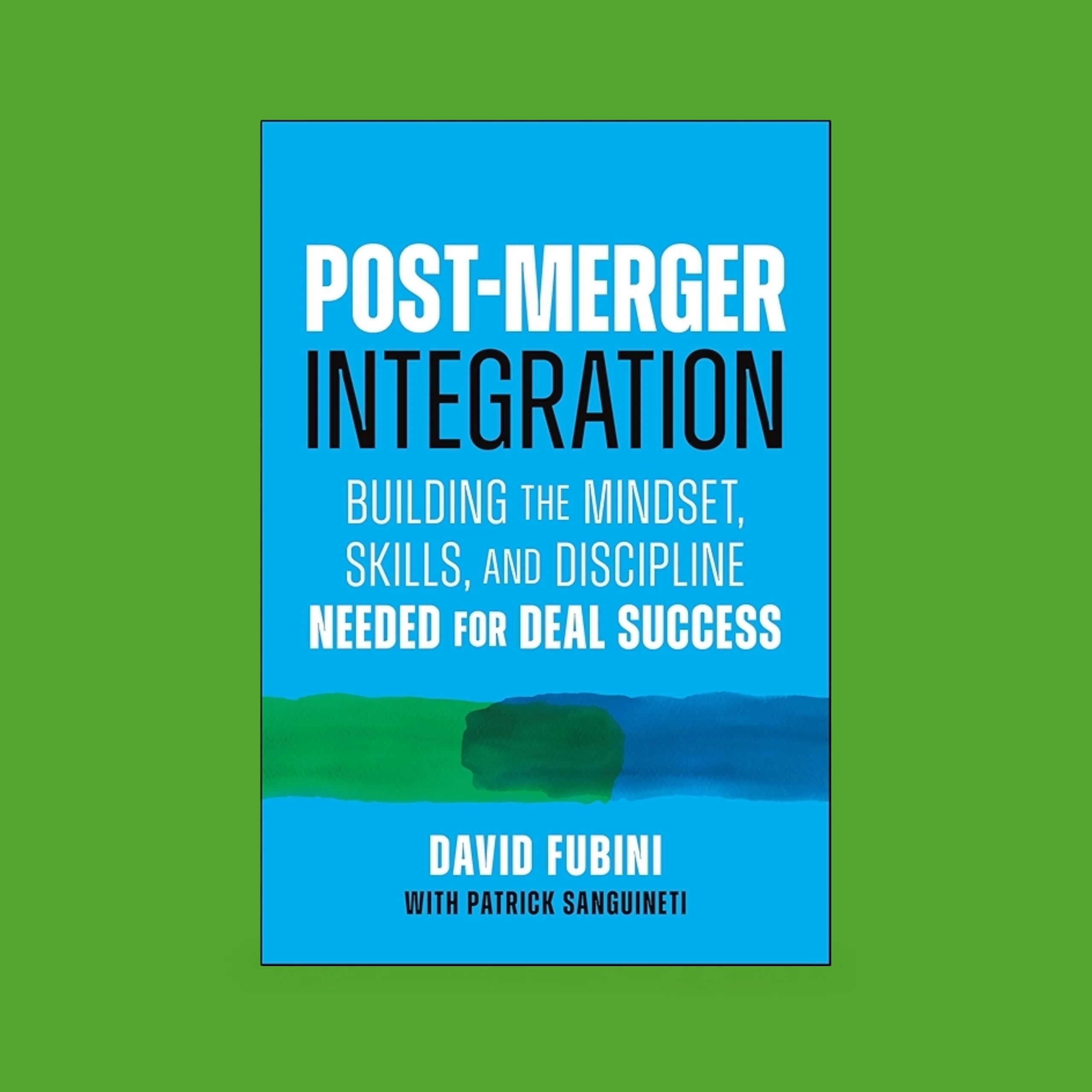
This is an excerpt from the book Post-Merger Integration: Building the Mindset, Skills, and Discipline Needed for Deal Success by David Fubini with Patrick Sanguineti. Wiley, June 2026.
In my privileged years working with excellent leaders, I’ve also seen many successful ways to run integration. The contexts could vary drastically—from airlines to beverages, pharmaceuticals, mining, and more—and the nuances of the integrations did too, but there were a few first principles that ran through all of them and contributed to their success. While it’s difficult to abide by all of them, they are true of every integration I’ve considered the most effective.
In each of these cases, the deal rationale dictated every turn of their respective integrations.
Cumulatively, they provide the way to chart a bespoke path to integration success. Ordered roughly in an accretional way, where each subsequent truth builds on its predecessor, they are the aggregated qualities that all Integration Leaders should embody.
Always keep the deal rationale central
Why did you do the deal? That’s the question that you, your lieutenants, and your advisors should be asking at every step of the integration, from initial planning all the way through final execution. The answer to that question is your deal rationale, and it is the answer that should anchor each and every one of your decisions.
A strong deal rationale is concrete and testable. It provides a specific reason (or set of reasons) behind your acquisition that you can work toward through integration, such that, if everything goes according to plan, it can be firmly proven or disproven by the time both companies are fully integrated. It is, to borrow a term that’s popular in private equity and venture capital circles, an investment thesis, a statement “that outlines how adding this particular business to your portfolio will make your company more valuable.” Or, in even simpler terms, something that “tells me why I would want to own this business.” It is the specific way you intend to use the transaction to achieve your company’s broader strategic goals, how you will translate the deal into “an important enabler of strategy and long-term value.”
The integration plan thus sets out to accomplish the goals outlined by the broad strategic plan in actionable, iterative fashion.
There are a few ways you can formulate this rationale (or thesis, or hypothesis) to increase your odds for overall success. In the simplest terms, “We’re acquiring x company for y reason in order to grow.” Or, “By acquiring x company, we can leverage a, b, and c assets to grow in y ways.” Alternatively, leaning into the hypothesis formulation, “If we acquire x company, then…” or, “We believe that, by acquiring x company, we will…” But in each of these framings, providing the specific reason(s) is absolutely required. A solid deal rationale is not, “We will acquire x company in order to grow,” full stop.
For Doug Parker, CEO of US Airways, the rationale was all about scale: By acquiring American Airlines, he could get the systems and facilities needed to make his company a global airline. Bob Gamgort, CEO of the coffee maker Keurig Green Mountain, realized that, by acquiring Dr Pepper Snapple, the combined company could leverage Pepper’s powerful direct-store-deliver network to drastically increase the distribution of its brands. Gary Saji and Takeshi Niinami, Chairman and President/CEO of the Japanese brewing and distilling group Suntory, bet that acquiring and integrating Beam Inc. would give them not only a foot in the US market, but also new leadership partners who could transform Suntory from a predominantly Japanese company into a truly global enterprise.
In each of these cases, the deal rationale dictated every turn of their respective integrations. This was the first major reason behind the success of their deals overall, and it was something they were able to accomplish through dedicated integration planning.
Integration planning: translating the deal rationale into action
Integration planning is where you take the rationale behind your deal and develop the steps your organization will need to prove it out. For now, I want to describe at a high level what sets it apart from other kinds of planning, including types you will have done earlier in the deal process.
If you’re prepping for a merger, you’ve most likely already been doing a lot of planning. It’s possible you’ve spent a year or even longer developing a sound corporate strategy, identifying a promising deal target, drafting up the anticipated synergies as part of the strategic plan, doing the due diligence, hearing from the investment bankers about how much value this should create, and perhaps, after all that work and planning, you’ve even (finally!) consummated the deal. This is already a significant endeavor. In fact, it’s so significant that it leads many leaders to confidently think that the right mix of compelling vision, advice from outside counsel, and inspirational communication will make the rest come together. Unfortunately, this point is not a climactic finale with a neat postscript to come. Instead, it’s the transition from strategic planning to the dedicated planning needed to launch the integration.
Strategic planning and integration planning represent distinct processes, but they are interconnected. The strategic plan sketches the goals for the deal in big-picture terms. The integration plan, meanwhile, lays out the path to accomplishing those goals (the deal rationale) in specific, granular detail. Though what goes into integration planning will change according to the nature of the deal, the integration plan is fundamentally built out of the deal rationale so that the new organization can realize the strategic goals intended for the deal.
These two planning efforts differ in their degree of granularity. Strategic planning is necessarily a high-level sketch because of the limitations of due diligence: Without full access to the acquired company, the planners on the acquiring side are producing more of a “best guess” to be proven—or tweaked, or even disproven—once more data is available.
Integration planning must be much more granular, specific, and comprehensive for it to be actionable. It’s also an iterative process of refining as the effort progresses. In practice, a strategic plan might sketch the framework for what the deal hopes to accomplish with about 20 lines of detail, while the integration plan must cover every decision point—large, medium, and small—with upwards of a thousand lines.
Think of this portion of the deal process like product testing. The strategic plan is the conceptual design that outlines the vision: It sketches out how the new product will be faster, lighter, and more agile than what came before. The integration plan, meanwhile, comprises the blueprint for each individual element, how they will fit together, and even which pieces of the old model get jettisoned, and how. Chances are that the first version of this plan will need adjusting: As you roll out the initial prototype, maybe some features aren’t working as intended, and perhaps some of the things you thought would be important can be done without, or saved for later. As you iterate and learn, you continually update your plan until you achieve the right balance.
The integration plan thus sets out to accomplish the goals outlined by the broad strategic plan in actionable, iterative fashion. Unlike the strategic plan, it will naturally evolve over the course of the effort as you continue to learn and implement decisions. This may feel like a voyage of discovery because even with rigorous due diligence, you’ll almost certainly find yourself uncovering unexpected opportunities (and problems) along the way—which, as it turns out, is a vital part of the process.
Excerpted with permission from the publisher, Wiley, from Post-Merger Integration: Building the Mindset, Skills, and Discipline Needed for Deal Success by David Fubini with Patrick Sanguineti. Copyright © 2026 by David G. Fubini. All rights reserved.