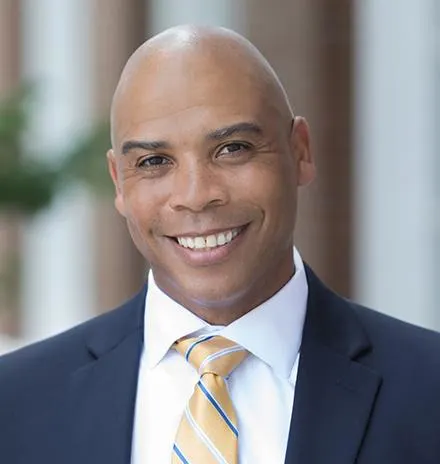

When Mark Clouse became CEO of the Campbell's Company, he saw a notable divide play out at schools near his Camden, New Jersey, headquarters: In one public school, students reached for candy and soda instead of cafeteria meals. In a nearby charter school, they lined up for salad.
Intent on boosting access to healthy foods in Camden’s public schools, in 2021 Campbell's launched Full Futures, a five-year, $5 million initiative to improve school nutrition. The funding infusion not only upgraded food infrastructure and training, but also offers a blueprint for community impact, says the case study "Campbell's Recipe for Advancing School Nutrition," coauthored by Harvard Business School Senior Lecturer Hise Gibson.
Like many manufacturing regions in the United States, Camden has been partly shaped by generations of redlining, a now-illegal practice that prevented mortgage lending to minority borrowers and spurred economic decline and poverty in affected neighborhoods. The impact on community health can be severe: US health officials have warned that many children, particularly in the poorest areas, aren’t eating enough produce and nutrient-rich foods.
A blueprint for community change
Ultimately, Full Futures helped the city’s public schools invest in equipment upgrades, nutrition education for staff, new recipes for school meals, and cooking classes for students and families.
But Clouse knew his company could only do so much to improve access to healthy foods. He hoped his actions would have a broader impact and offer a roadmap for other companies.
“We are not going to change the world, but we can be one great example of what it looks like and inspire others to follow,” Clouse says in the case.
A sign that Clouse’s efforts have influenced others: In nearby Newark, New Jersey, drugmaker Novo Nordisk looked to the Campbell’s program as inspiration for its “Coalition for Healthy Food.” The company launched the initiative in 2024 by investing $3.8 million to ensure that all students in the city’s schools had access to fresh, healthy, and culturally relevant foods.
Campbell's was in the spotlight recently when a lawsuit from a former employee revealed that another executive had made disparaging remarks about the company's food and the people who eat it. The company has since fired that executive.
Gibson, who studied the initiative with Duke University’s Professor F. Christopher Eaglin and HBS researcher Ai-Ling Jamila Malone, says Campbell's journey offers four lessons for organizations trying to drive community change while earning trust.
1. Build partnerships to build credibility
For decades, Campbell’s Foundation used what executives called a “confetti approach” to philanthropy, scattering small grants across many causes. Earlier attempts at community work in Camden had not gone smoothly, coming off as paternalistic to some residents.
“It almost came across as condescending. You're the big company, you have all the money, and you're here to help,” Gibson explains.
After all, Gibson says, true partnership requires more than merely writing checks. Full Futures took a different approach, asking the Camden City School District to take the lead in building credibility in a community long scarred by inequitable investment. “The idea is to partner with the community, the civic leaders, the educators … and really understand what’s going on,” says Gibson. “They said, ‘we’re not here to fix you; we’re here to partner.’”
It wasn’t easy at first, as the partners navigated sensitive power dynamics among district officials in charge of school operations, the company providing the funding, and other nonprofits involved.
But Full Futures persisted, bringing together more than a dozen partners, including local nonprofits and food banks. Campbell’s served as a convener, not commander, and progress came from keeping an open mind and weaving players together. “They listened and co-created plans, instead of dictating,” says Gibson.
2. Invest in long-term progress
Clouse and his team demonstrated that they would stick around for years after the initial season and work through issues.
“For any real change to happen, the organization has to be in it for the long term,” Gibson says.
Campbell’s committed to five-year funding cycles and invested in improvements that would outlast any single executive at the company, from kitchen retrofits to updated procurement policies. These structural changes helped tie the work to institutional processes rather than individual champions.
Also, to show an even greater commitment, the Full Futures initiative expanded to Campbell’s facilities in North Carolina and Pennsylvania. New locations required tinkering with the model; for example, in North Carolina, the team partnered with the career and technical education program instead of the school nutrition department.
3. Define success by impact, not optics
Many corporate social responsibility initiatives focus on outputs—pounds of food distributed and volunteer hours logged—rather than long-term outcomes. Gibson calls impact measurement one of the hardest parts of community engagement.
“We’re talking about soft and vague things,” he says. “Things that don’t have a hard ROI.”
Measuring the program's impact required patience and collaboration. Full Futures worked with existing data sources and school systems, tying program activities to longer-term indicators, like student engagement, food access, knowledge and behavior change, and school climate, rather than short-term metrics alone. Goodwill, like pride in the partnership and better community relationships, also counted.
“Leaders need to be clear about intent—defining outcomes, communicating purpose, and setting boundaries so others can act,” Gibson explains.
4. Take charge and show you care
Executives can’t outsource authentic community engagement, Gibson says. For Clouse, that meant visiting schools, meeting cafeteria staff, and talking directly to students.
“When the board and CEO care, everyone cares,” Gibson says.
He also notes that leaders later in their careers are often more willing to take bold risks to make an impact. Clouse, who was close to retirement, may have felt he had little to lose and wanted to focus on his legacy. But Gibson says younger leaders need to step up sooner: “Ideally, we need leaders taking those risks earlier.”
Updated on February 6, 2026 to reflect some nuances of the program.
Have feedback for us?
Campbell's Recipe for Advancing School Nutrition
Gibson, Hise O., F. Christopher Eaglin, and Ai-Ling Jamila Malone. "Campbell's Recipe for Advancing School Nutrition." Harvard Business School Case 625-117, April 2025.