
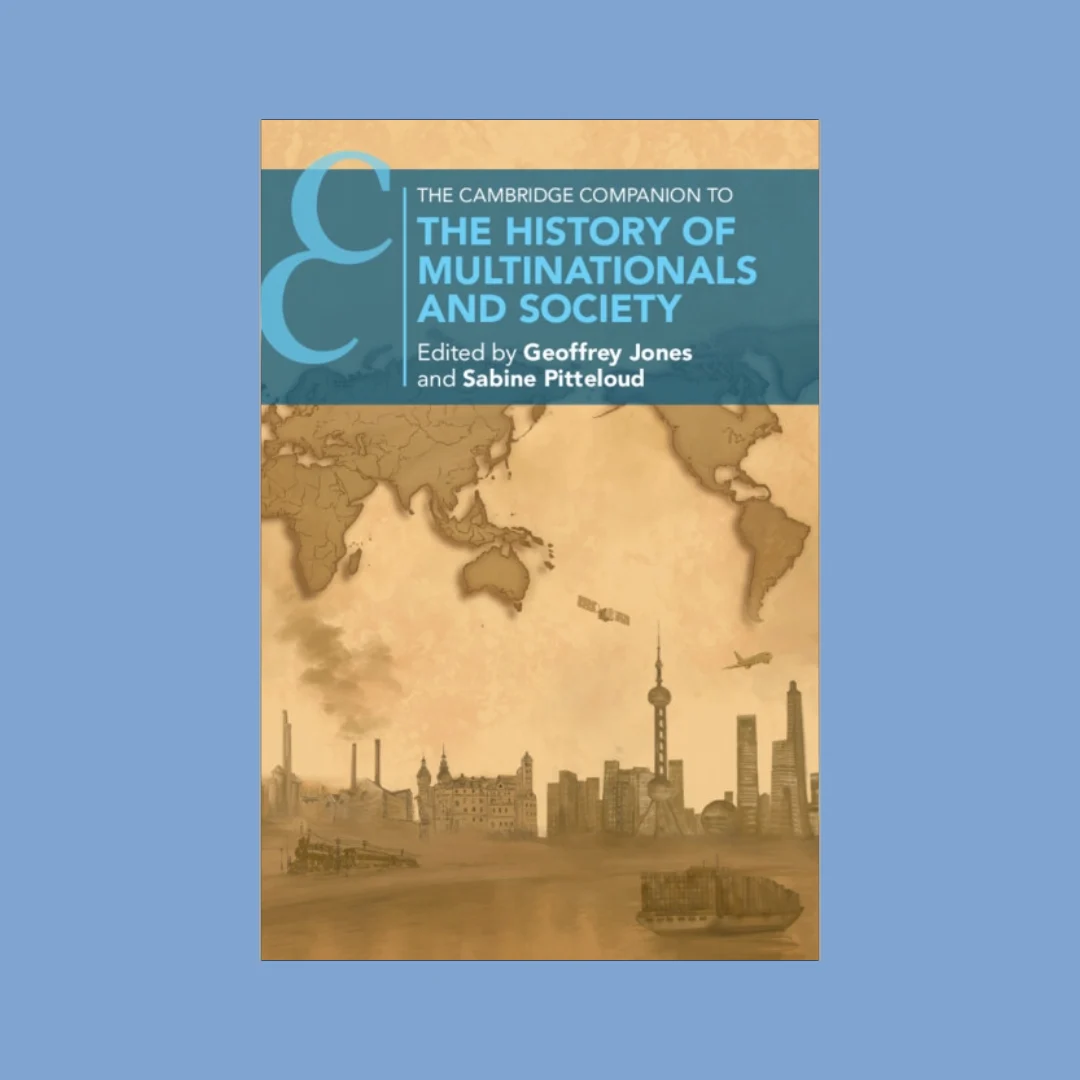
This excerpt was adapted from the book The Cambridge Companion to the History of Multinationals and Society, edited by Geoffrey Jones and Sabine Pitteloud. Cambridge University Press, February 2026.
A consistent picture of multinational enterprise (MNE) engagement in corruption is (by definition) hard to ascertain. It is silent unless exposed in a legal case, by an investigative journalist, or by a business historian with access to corporate archives. An aggregate statement of how much MNEs have engaged in corruption over time is impossible, therefore.
A business history and firm-level perspective allows a clearer view of the role of MNEs as active agents.
Before World War II: Siemens in Japan
MNE investment was heavily concentrated in the nonaffluent world before World War II, and mainly engaged in commodities and related services, so it is likely that historically forms of corruption were quite widespread. The securing of concessions from autocratic and corrupt governments in the non-Western world often involved bribery before World War II.
Evidence collected during the trial revealed that Siemens ... paid large bribes to high-ranking naval officers to secure orders.
A well-documented corruption scandal occurred in Meiji Japan involving the German electrical goods MNE Siemens. In 1914, a former employee of Siemens’ Tokyo office was found guilty by a German court of having stolen company documents and attempted extortion. Evidence collected during the trial revealed that Siemens (as well as its British competitor Vickers) paid large bribes to high-ranking naval officers to secure orders.
The Japanese navy was one of the largest spending departments, so it was likely that the sums involved were substantial. The practice of naval officers accepting “commissions” dated back to at least the 1890s, and the legal system was ambiguous about their legitimacy. Although heavy sentences were passed on to Mitsui employees involved in handling illicit payments, they were overturned by the appeal court.
Post-war era: Lockheed and Adidas
After World War II there were more spectacular instances of corruption in the armaments industry. The US aerospace MNE Lockheed made extensive use of bribery to negotiate the sale of aircraft in Japan, Germany, and the Netherlands between the 1950s and the 1970s. In the context of the Cold War and a booming demand for fighter jets, Lockheed invested a huge amount of money in a new jet, the F-104 or Starfighter, which was launched in 1954. The plane had major drawbacks, including that complex electronics were necessary to keep the aircraft stable, and, since pressurizing equipment was removed to save on weight, pilots had to wear uncomfortable space suits.
When the US Air Force bought only a few planes, Lockheed turned to international markets, but despite some redesign the plane still had limited attractions to foreign militaries. Lockheed’s executives resorted to irregular sales methods. In countries around the world, Lockheed’s strategy was to identify intermediaries with connections to the highest reaches of governments who could sway purchase decisions, for a price, and with access to a pool of funds that could not be tracked too closely.
Although the use of bribery and corruption by MNEs in the international arms industry attracted the greatest headlines, the practice was evident in different industries. During the 1950s and 1960s, for example, the competing German sportswear firms Adidas and Puma engaged in widespread bribery aimed at getting their sports shoes on the feet of athletes.
The context was the amateur rules of all the world’s sports associations that prohibited direct commercial sponsorship. During the 1970s and 1980s Horst Dassler, the leading member of the Dassler family that owned Adidas, also diversified into sports sponsorship on his account, engaging in bribery and corruption to capture the leaderships of sports associations such as the Fédération Internationale de Football Association and eventually the International Olympic Committee and open them to sports sponsorship.
Dassler operated the business first through a company registered in Monte Carlo, Société Monégasque de Promotion Internationale and subsequently though a joint venture called International Sport and Leisure (ISL) with Dentsu, Japan’s largest advertising firm, based in Lucerne, Switzerland. Bribery was legal in Switzerland in this period. When the ISL collapsed into bankruptcy in 2001, long after Dassler’s death, it was discovered that the company had paid out US $120 million in bribes to leading sports officials to secure marketing and television rights contracts.
Turn of the millennium: Enron
Dassler’s use of Monte Carlo and Switzerland was part of a much wider trend that facilitated corporate corruption. The offshore financial centers in the Caribbean and elsewhere—such as Hong Kong, which provided the basis for the extensive “roundtripping of Chinese FDI” grew exponentially from the 1980s. They were not only tax havens, but also opaque and secretive. They provided means for MNEs to engage in corruption with no public scrutiny.
This was the case of US energy trader Enron, which went bankrupt in 2011 following major accounting fraud. As several studies have shown, the corporate culture grew progressively more corrupt over the course of the 1990s. Enron’s fraudulent accounts were made possible by extensive use of international financial centers. The company used phony “prepay” transactions to hide US $8 billion in debt, each transaction of which was knowingly facilitated by a major financial institution.
JPMorgan Chase and Citigroup were among the banks that used offshore shell companies they secretly controlled to provide billions of dollars in cash loans to Enron while allowing Enron to characterize the loans on its books as income from trading deals it had secured with those offshore entities.
2000s to present: Siemens and Airbus
What is striking in many of these cases is that corruption was not driven by aberrant managers or ethically depraved chief executives, but was the product of system-wide features of corporate cultures.
In 2008 Siemens (again) was revealed to be engaged in widespread and systematic foreign bribery in at least ten countries between 2001 and 2007. The US Securities and Exchange Commission fined the company US $1.6 billion having established that between 2001 and 2007 dubious payments had been made in 5,468 cases, including 4,283 incidents of corruption. Offenses before 2001 were not investigated. The company’s entire management board was replaced.
Airbus operated through intermediaries who received indirect bribe payments through commissions and sometimes directly in cash.
Siemens’s modus operandi was, as in many cases, to bribe through intermediaries. Bribes for two Italian officials were channeled through an intermediary based in Dubai. Intermediaries in Cyprus and Dubai were used to bribe Venezuelan officials. Officials in Israel, mainland China, and Vietnam were bribed using Hong Kong-based consultants.
There are clear parallels between the case of Siemens and the bribery scandal of the Dutch-registered aviation MNE Airbus. In 2020 Airbus agreed to pay a record US $4 billion to the governments in the United States, France, and Britain in fines to settle foreign bribery charges accrued between 2008 and 2015. The case documented the use of large bribes to win contracts in Ghana, Sri Lanka, Malaysia, Taiwan, and Indonesia. For example, Airbus offered US $16.84 million to the wife of an executive of Sri Lankan Airlines to purchase ten aircraft and to lease an additional four planes.
Airbus operated through intermediaries who received indirect bribe payments through commissions and sometimes directly in cash. To avoid Airbus’s compliance structures, the identity of some of the [business partners] was concealed, and documentation was created to disguise illicit payments. These practices became embedded in the corporate culture.
When corruption is systemized
Strikingly, although bribery and corruption are often associated in the public mind with rogue individuals, it has historically been more often the product of miscreant corporate cultures. Whether in Siemens or other MNEs, a part at least of the organization systemized corruption, which enabled managers to rationalize it as a source of competitive advantage, especially in countries seen as already corrupt.
Excerpted with permission from the publisher, Cambridge University Press, from The Cambridge Companion to the History of Multinationals and Society, edited by Geoffrey Jones and Sabine Pitteloud. Copyright © 2026 by Cambridge University Press. All rights reserved.