
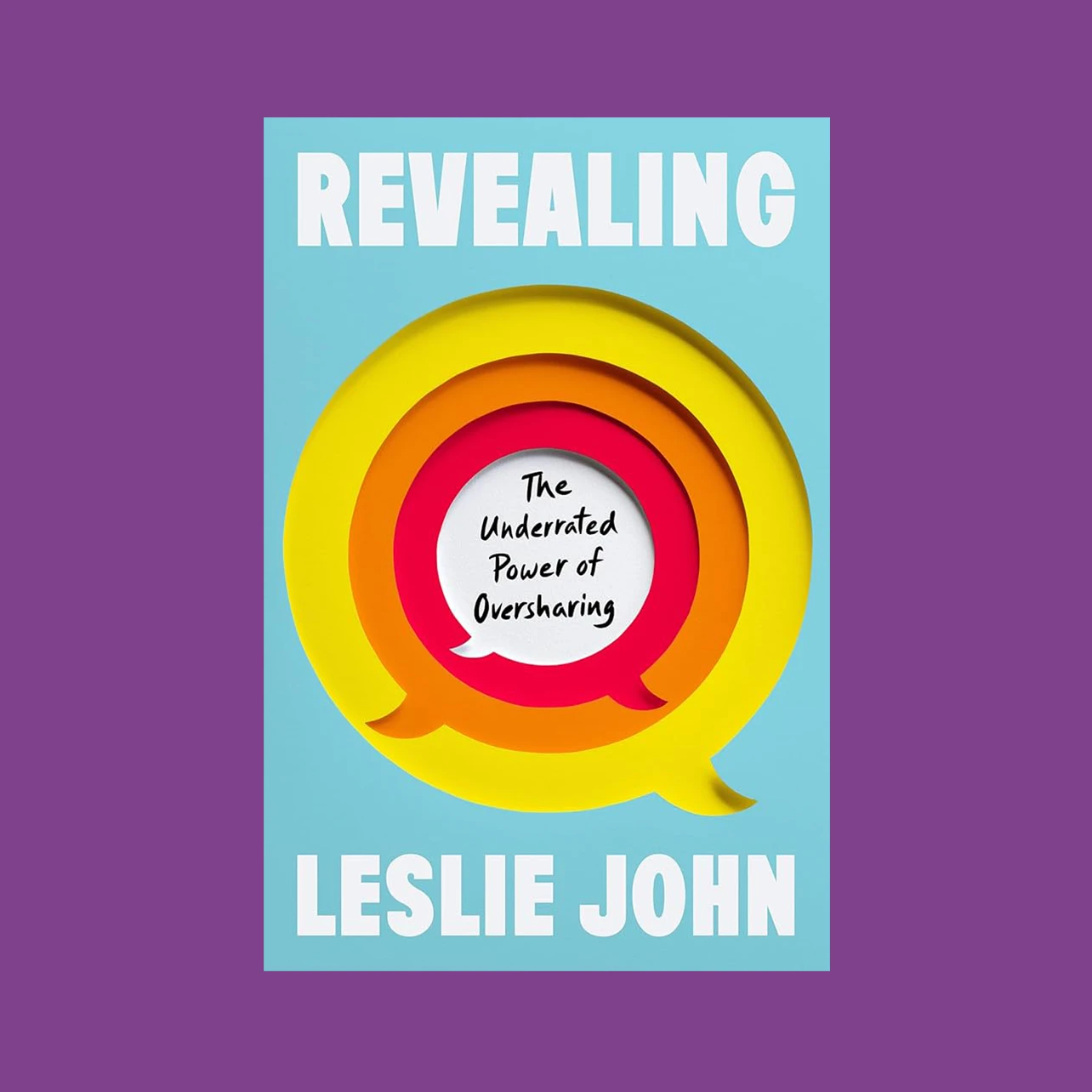
This excerpt was adapted from the book Revealing: The Underrated Power of Oversharing, written by Leslie John. Penguin Random House, February 2026.
Pretend you’re attending the famous game show Let’s Make a Deal, which started airing in 1963.
In the show, various audience members dressed in attention-grabbing “pick me!” costumes are invited to make trades with the host, the charming and perennially well-tanned Monty Hall. (Fun fact: He’s Canadian, like me! Another fun fact: We Canadians like to point out who is Canadian!)
Imagine Monty invites you to stand and shows you three doors onstage: Door 1, Door 2, and Door 3. Behind one of the doors is a prize: something “fabulous,” Monty intones, like a “braaaaaand new car!” Behind the other two doors? Zonks, which are dud prizes, such as trips to nonexistent destinations, play money, broken appliances, ridiculously large amounts of food, and live animals—yes, most commonly, goats.
And the thing is, even when people are told the math—or intellectually grasp that switching gives them a better chance of winning the prize—they often still resist switching.
Monty asks you to choose a door. You choose Door 1. Next, Monty opens one of the doors you didn’t pick, Door 3. A dramatically ominous tune sounds out, one so ingrained in my and my brother’s memory that we still intone it when something disappointing happens and we’re trying to make light of it. Behind the door is a Zonk—round-trip tickets to Zonklandia. Now, before Monty opens your chosen door, Door 1, which you hope hides a car, he wants to know: Would you like to switch to Door 2 (which remains closed)?
If you’re like most people, you choose not to switch. You stick to your guns with Door 1. It feels right. But is this a good strategy? Will it maximize your chance of winning the prize? The answer is a resounding no. You should always switch. If this is not intuitive to you, you are not alone. But the bottom line is that staying only wins on the occasions where you happened to choose the winning door from the start.
The trick is that Monty knows where the car is, and before he asks you whether you want to switch, he always opens a goat door. That means he’s actually helping you, by taking a dud door out of the running. Think of it this way: When you first pick, there’s a 1-in-3 chance you choose the car and a 2-in-3 chance you don’t. So, most of the time, your first pick is wrong. Monty then shows you which of the other two doors is a goat, leaving the other door unopened.
If you switch, you’re betting that your first pick was wrong (which it usually is). And so, chances are, switching is a winning move. If you stay, you only win in the 1 out of 3 times you guessed right at the start. But if you switch, you win on 2 out of 3 occasions. Switching doubles your odds of winning.
The Monty Hall problem has been studied a lot (ad nauseam?) in behavioral science. And the thing is, even when people are told the math—or intellectually grasp that switching gives them a better chance of winning the prize—they often still resist switching. I myself might even insist on staying. But staying is illogical—you’re giving up a free chance to double your odds. And yet, many of us think, “Whatever, I’m sticking with my door.” Totally fair. Because there’s a deeply compelling psycho-logic to staying.
Switching, only to discover you were right in the first place, really sucks. “If I’d only just stuck with my gut!” you chide yourself. By contrast, losing the other way—by failing to switch to a winning door (when you chose a losing door in the first place) doesn’t feel nearly as bad. This is weird in a way, because in both cases, the “objective outcome” is the same: You don’t win the car. And yet one hurts much more than the other. What’s going on?
In disclosure dilemmas, omission bias pushes us toward silence.
At the crux of this asymmetry is something that psychologists call omission bias, and it refers to how a bad outcome feels worse when it arises from something we did—an action we took—as opposed to when it arises from an inaction, or something we didn’t do. In other words, so-called “sins of commission” (bad things that arise from our actions) are more poignant than “sins of omission” (bad things that arise because of a failure to act).
This bias makes a certain kind of sense. Actions often are more intentional than inactions. It’s worse to shove someone into a fire than to fail to pull them out. And our legal systems reflect this: We generally punish harmful actions more than harmful omissions. Most states don’t even require you to help someone in danger if you’re just a bystander.
But omission bias can also lead us astray. We underblame ourselves for things we didn’t do but probably should have done (sins of omission). And we overblame ourselves for things we did, in cases where our actions didn’t actually cause the bad outcome. We suffer unnecessarily, convinced we did harm when we didn’t—when the bad thing would have happened anyway. In disclosure dilemmas, omission bias pushes us toward silence. But sometimes, silence leaves out the very thing that matters most. And that’s where the real trouble begins.
From REVEALING: The Underrated Power of Oversharing by Leslie John published on February 24, 2026 by Riverhead Books, an imprint of Penguin Publishing Group, a division of Penguin Random House LLC. Copyright © 2026 by Leslie John