
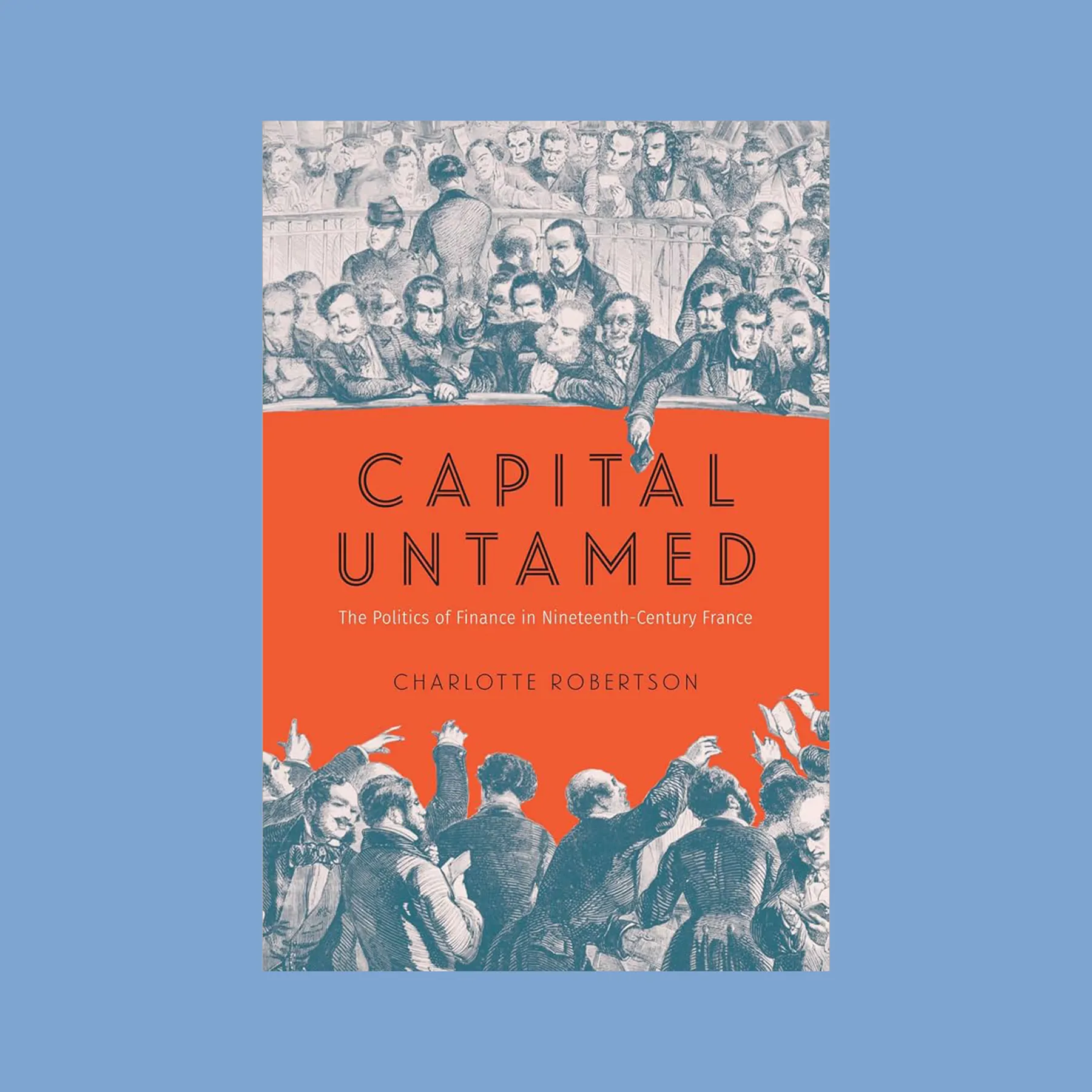
This is an excerpt from the book Capital Untamed: The Politics of Finance in Nineteenth-Century France by Charlotte Robertson. The University of Chicago Press, June 2026.
The stories told about the relationship between the state and financial markets in the modern era have traditionally revolved around determinations of more or less state regulation, more or less market freedom, and how these elements have been reconfigured across historical regimes of political economy.
The received wisdom is that the nineteenth century marked the period of classical liberalism in Europe, before the crises of the 1930s drove states governing advanced economies to assume more interventionist postures in the organization of investment and financial markets. The post–World War II consensus in Europe and the United States held that if markets were tightly bound by regulation, they could be made to serve the needs of the real economy.
This model of “embedded liberalism,” which entailed state control over finance, was understood as a necessary condition for ensuring stability by encouraging investment into productive capital formation and preventing speculative excesses. The neoliberal consensus that emerged in the 1980s assumed the opposite: that if markets were unbound, they would stimulate growth and wealth creation.
The premise was that financial deregulation would enhance efficiency, unlocking private capital for productive investment while reducing distortions introduced by state intervention. Beyond the ideal types of contained or unbridled finance, scholars have drawn attention to the qualitative complexity of efforts by states in the twentieth century to do more—to steer capital toward a variety of social, political, and economic goals through planning, industrial policy, credit policy, and other instruments.
This book does not aim to redefine capitalism, propose a new theory of capital, or periodize a distinct capitalist era, all of which are important and ongoing projects in a rich and expanding literature on the history of capitalism. Instead, it explores how a particular dynamic between political authority and financial markets shaped nineteenth-century France—foreshadowing a form of state-finance entanglement that would become increasingly typical of modern capitalism.
The analysis does not proceed from an explicit application of deductive theory but from a close reading of historical archives. From this reading, I have arrived at two concepts—instrumental and autonomous finance—to describe the twin poles of this dynamic, concepts that I believe are heuristically useful for identifying the evolution of power relations between the modern state and the financial markets, which both enable and constrain state action.
Postrevolutionary France offers a productive starting point for this line of inquiry because of the striking proliferation of ideas and projects to instrumentalize finance that emerged there and then. In France by the 1830s, financial thought was not confined to the realm of profit-making economic activity; it also functioned as a mode of political thought.
A variety of historical actors—from theorists and politicians to laborers, bankers, and radical reformers—embraced financial vehicles, instruments, plans and programs because they appeared uniquely placed to offer pragmatic solutions to the impasses of their times. On the one hand, its appeal derived from the political instability of the era; finance presented the prospect of salutary revolutionary change without revolutionary upheaval. On the other hand, this consciousness stemmed from the much larger capital demands and expansion of market-based financing that arose alongside early industrialization.
Through its aggregation and centralization of funds, the financial market offered resources that neither private individuals nor the state had and that therefore became a tempting target for ambitious plans. Promoters of various projects embraced financial innovations or reorganizations of existing financial investment practices as means of attaining a variety of objectives that they believed would not necessarily or naturally emerge otherwise: These included accelerating industrial development, securing domestic and international peace, fostering deconcentrated community-based enterprise, morally uplifting workers, expanding infrastructure, and establishing political legitimacy.
During the Bonapartist regime of the 1850s, the ambition to instrumentalize finance benefited from the enabling force of authoritarian power. The regime sponsored new joint-stock banks, notably the Crédit mobilier, which issued publicly traded securities to finance its lending to capital-intensive infrastructure projects, such as railroads and urban improvements, without placing a direct burden on government finances. Instrumentalizing finance also took the form of direct market interventions intended to reconfigure investor incentives and steer the public’s savings in directions that capitalists otherwise neglected or undervalued—an effort to “derisk” critical investment priorities avant la lettre.
This effort did not conform to familiar twentieth-century paradigms of restricting or freeing finance, or of regulating or deregulating it. Instrumentalizing finance entailed a greater degree of state involvement in financial markets geared toward qualitatively shaping the composition of private investments enabled by public markets, before the emergence of modern planning or capital controls. Interventions occurred in a remarkably porous marketplace, in comparison to the regimes that would follow a century later. It is important to understand this era of experimental interventionism on its own terms. Doing so allows us to appreciate better both the continuities and the adaptations that would follow.
Nineteenth-century France was not the first era in which the instrumentalization of finance was attempted. John Law’s notorious financial experiment of 1720, which sought to resolve France’s crippling sovereign debt crisis through the creation of a paper currency backed by colonial trade monopolies, reflected expansive ambitions to reconfigure the social and political compact and underwrite European peace, as John Shovlin and Arnaud Orain have argued. The assignats, which monetized confiscated church lands during the French Revolution, as recounted by Rebecca Spang, were intended to be a conservative solution to a fiscal and political crisis but turned out to be far more disruptive than intended.
In postrevolutionary France, projects to instrumentalize finance were no longer the vision of a single theorist or coterie of officials enlisting adherents to enact an abstract plan. Programs emerged from a wide range of historical actors—from socialist bankers to artisans in small workshops to the Bonapartist claimant to the throne—proposing different capital arrangements as pathways to transformative social change.
What sets the regime of Napoleon III apart is that the strategy to instrumentalize finance extended beyond the management of credit and money to encompass the broader capital market, animated and complicated by an expanding universe of corporate debt and equity, as well as foreign securities and derivatives. In a pivot away from governmental precedent, the Bonapartist state actively stimulated corporate capitalism by authorizing more joint-stock corporations (sociétés anonymes).
This process shifted the overall composition of the French capital markets, such that corporate securities surpassed public debt in terms of total market capitalization for the very first time. By 1869, the organization of French capital mobilization had undergone a drastic structural change, with private issues on the Bourse far outpacing the important role formerly played by notarial credit networks. The rapid expansion and diversification of tradable financial securities, as well as the concomitant proliferation of derivatives, in turn posed new challenges for state-market relations.
Reprinted with permission from Capital Untamed by Charlotte Robertson, published by the University of Chicago Press. © 2026. All rights reserved.