
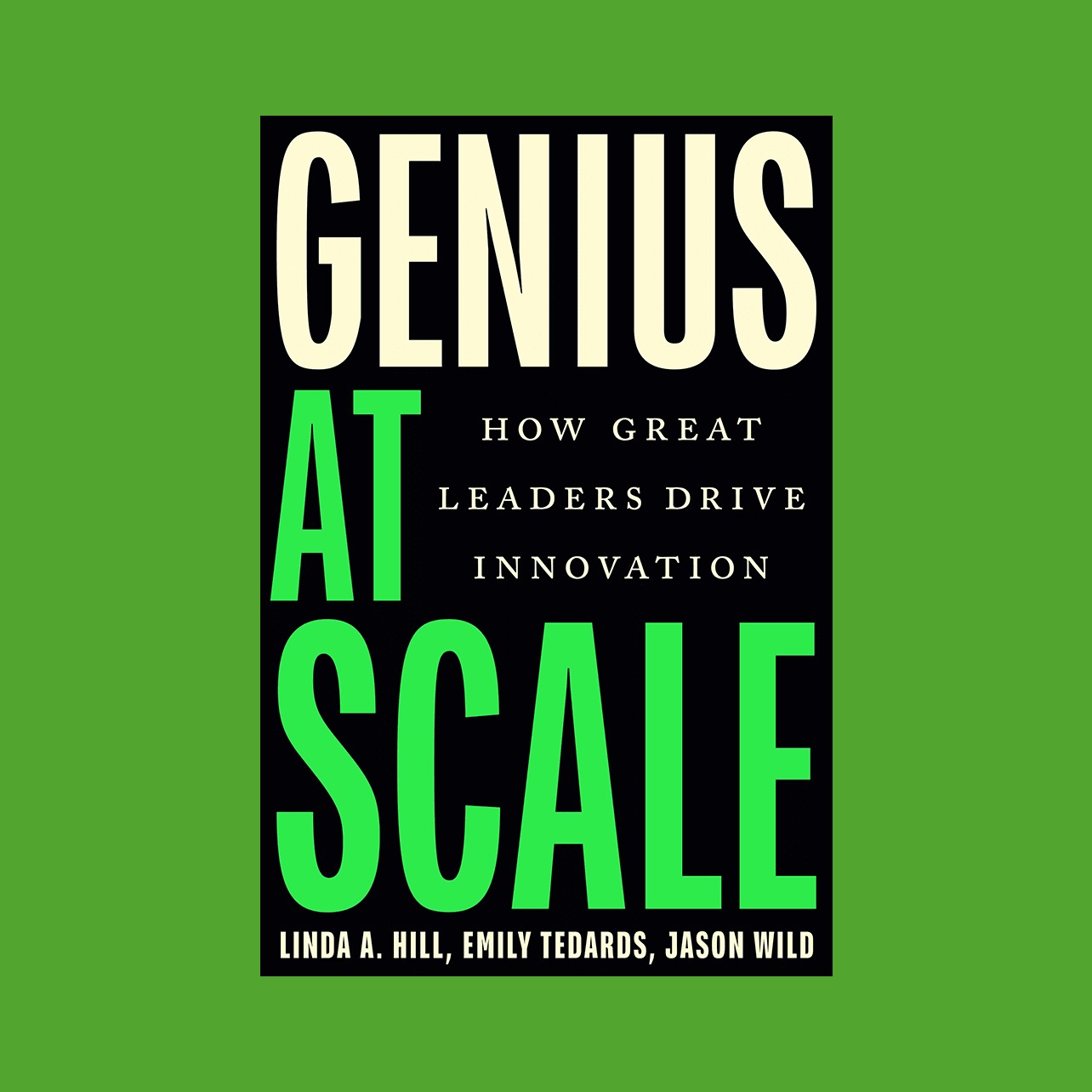
This is an excerpt from the book Genius at Scale: How Great Leaders Drive Innovation by Linda A. Hill, Emily Tedards, and Jason Wild. Published by Harvard Business Review Press in March 2026.
Whether developing a vaccine in record time or extending financial services to billions of unbanked people, the exceptional leaders [featured in our] book managed to get multiple organizations to collaborate, experiment, and learn together. These leaders saw emerging technologies not as disruptive but as tools for unleashing and harnessing collective genius at scale—what we call genius at scale for short.
These leaders saw emerging technologies not as disruptive but as tools for unleashing and harnessing collective genius at scale—what we call genius at scale for short.
Genius at scale is not simply about activating collective genius in-house, but forging partnerships and strategic movements, amplifying influence by spurring cocreation across sectors (companies, government, civil society) or the globe.
To drive genius at scale, these leaders relied on a repertoire of interrelated roles: architect, bridger, and catalyst—what we came to think of as the ABCs of leading innovation. These roles might be visualized as concentric circles.
Architects largely work within their team or organization, building innovative communities by fostering the culture and capabilities that enable cocreation.
Bridgers work at the boundaries of their enterprises, building partnerships with those outside their walls to access essential talent and tools for innovation.
Catalysts go even further, launching movements that activate and spread innovation across broader ecosystems.
Architects
The architect makes their organization collaborative-ready and is thus the foundation of the ABCs. Architects understand that they cannot mandate innovation; instead, they invite their colleagues to think and act differently by reshaping the social environment in which they do their work. Architects invite everyone in their organization to participate in innovation and build the culture and capabilities required for them to do so.
By instilling shared purpose, values, and rules of engagement, architects build a sense of community that encourages the willingness to innovate. By helping their colleagues amplify and navigate their diversity of thought, and overcome fears of risk and failure, architects embed the ability to collaborate, experiment, and learn.
Architects pay attention to the emotional, intellectual, and organizational barriers to innovation and are always on the lookout for resolutions. Are silos hindering collaboration? Are performance or talent-management systems deterring risk-taking?
Do people have the digital tools and data they need to experiment and learn expeditiously? And perhaps most importantly, is leadership the problem—are leaders getting in the way? These are just a few of the hurdles we’ll see our architects grapple with as they unleash collective genius in their organizations.
Bridgers
Leaders today recognize that they rely on external talent and tools to bring their organizations into the future. Bridgers have the unenviable job of facilitating cocreation between their internal colleagues and partners outside their organizational boundaries—a role that requires exercising influence without formal authority.
Bridgers build partnerships with different organizations—often with vastly different priorities, constraints, capabilities, and work styles—to innovate together. In doing so, they build relationships grounded in mutual trust, influence, and commitment. Bridgers carefully curate potential partners; they translate across those partners to build common understanding; and integrate their disparate intentions and actions so they can develop and scale new products, services, and processes.
Bridging is a difficult, hands-on, time-intensive form of leadership, and it is often underappreciated since much of it happens behind the scenes. Innovating feels all the more complex and risky when working with outsiders. A high degree of emotional intelligence, patience, and diplomacy is required for bridgers to navigate the vexing conflicts that arise.
Catalysts
If architects build innovative communities within organizations and bridgers build innovative partnerships at their boundaries, then catalysts galvanize movements to drive innovation far beyond their organization’s boundaries.
Catalysts map their ecosystems: the evolving landscape of stakeholders, their interdependencies, along with emergent opportunities and barriers to innovation. They seed tangible opportunities for others to engage in multiparty cocreation, fulfilling individual priorities while advancing collective aspirations.
The ABC roles are not only complementary, but as you will see, our leaders often span multiple roles or deliberately choose to don one mantle while delegating the others to trusted colleagues.
Last, catalysts cultivate those seeds, equipping stakeholders with the mindsets, relationships, and tools needed to sustain the movement’s momentum over time. The ecosystem metaphor in business practice and research tends to evoke a gatekeeping mindset: positioning one’s organization as the central hub controlling information, resource flows, and the customer interface in a value chain. The catalysts in our book adopt a different approach, emphasizing synergies, sustainability, and shared value.
The ABC roles are not only complementary, but as you will see, our leaders often span multiple roles or deliberately choose to don one mantle while delegating the others to trusted colleagues. That said, in this book, we focus each story on the primary role—architect, bridger, or catalyst—that a particular leader played to accomplish extraordinary things for their organization.
Reprinted by permission of Harvard Business Review Press. Excerpted from Genius at Scale: How Great Leaders Drive Innovation by Linda A. Hill, Emily Tedards, and Jason Wild. Copyright 2026. All rights reserved.