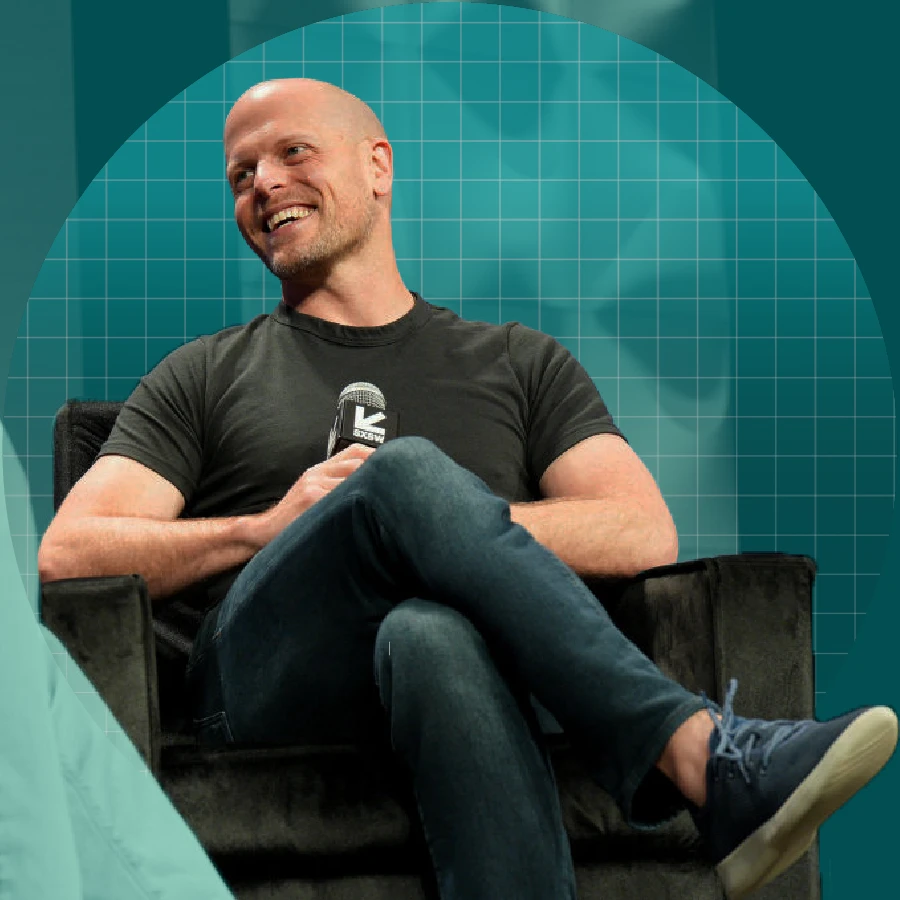
Tim Ferriss—podcaster, author, angel investor, and self-described “human guinea pig”—built his career by questioning conventional wisdom. In 2024, he faced a question of his own: Was it time to walk away from the podcast that made him one of the most influential voices in digital media?
After a decade hosting his successful podcast, The Tim Ferriss Show—which has generated over a billion downloads and eight-figure annual revenue with just three employees—Ferriss hit pause. Not because the show was failing. Because the industry had changed.
“When I started the podcast in 2014, it was a blue ocean,” Ferriss recalled. “Flash forward 10 years: everyone has a podcast. Even your grandma has a podcast. It’s become a red ocean—saturated and competitive.”
For someone who’s made a career out of finding white space, saturation is a red flag.
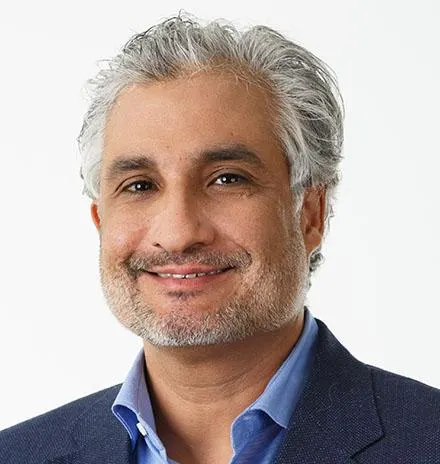
“In many ways, Tim is at the peak of his game,” observes Harvard Business School Senior Lecturer Reza Satchu, author of the case study, “Tim Ferriss: What Might This Look Like If It Were Easy?” “Most people would look at it and say, ‘Sure, there’s more competition, but how could he possibly give his podcast up?’”
But that question misses the point.
“The question isn’t whether you can compete—it’s whether you should,” explains Denise Koller, an HBS research associate who coauthored the case, first published in 2024. “Tim built his career finding, as he put it, blue oceans—uncontested market space. The moment a space turns red, when everyone's competing for the same audience, the same sponsors, he doesn't join the bloodbath. Instead, he takes a step back and asks: ‘What’s an entirely different game I could play? Where can I be in a ‘category of one’?’”
This reflective process becomes even more critical as artificial intelligence reshapes the workplace and pushes workers in many industries to question whether their career choices are sound and survivable. Those who apply Ferriss’ entrepreneurial principles will be the ones who are more likely to come out ahead, says Satchu.
A timeline of Ferriss’ life provides a framework for any leader questioning their own next move: Pause before burnout, evaluate what still works, and redesign your next chapter with the same creativity you used to build it.
1977
The infomercial education
Ferriss was born prematurely into a working-class family on Long Island. His parents credited his lifelong insomnia to the lights and noise from his early days in the neonatal unit. Unable to sleep, young Ferriss watched infomercials late into the night, calling them “the poor man’s PhD in sales psychology, and my business school on Long Island.”
“I’m looking at these infomercials, and people are sailing on yachts and taking trips around the world. That simply wasn’t the life my family had,” Ferris says. “My parents had limited options and sold time for money. They did the best they could, but more money—at least what I saw on TV—seemed to give you freedom.”
Lesson: Freedom doesn't come from working harder—it comes from building income that isn't tied to your time.
1995
Learning the hard way
At Princeton, Ferriss offered seminars teaching speed reading, charging $50 per person with a 110% money-back guarantee. Three hours, $1,500. “I remember having all the checks and cash in my jacket, and holding them in my hands,” he says in the case. “I went from $8 an hour working in libraries to $500 an hour. But it still required me in one place, trading time for money.” Ferriss’ attempts to scale his seminar via VHS tapes failed, but he learned from the experience.
Lesson: Success doesn’t happen all at once. But small victories compound, leading to broader learning.
1999
Controlling what can be controlled
Ferriss wrestled with severe depression while struggling with his senior thesis. He turned pain into power by channeling his energy into Chinese kickboxing, winning a national title at 165 pounds. Shifting focus to competitive martial arts gave Ferriss “a deadline and a forcing function.”
Lesson: When you’re stuck, focus on something that feels more manageable to control. Firm deadlines can help.
2001
Finding the confidence to act on ideas
Ferriss founded the startup BrainQuicken (later BodyQuick), a sports nutrition startup. Within months, 80-hour workweeks threatened to consume him, and a long-term relationship ended. Rather than accept his fate, he made a choice: automate the business or shut it down. “This iteration of this idea was turning into a prison of my own making. If I had to shut it down and start over, I had the confidence I could figure it out, since I’d survived failures before.”
Lesson: Confidence is important—and action is key. “Every regular person needs to believe that the ideas they have are worth exploring,” says Satchu. “Most people will never explore the ideas because they assume someone else with more resources has already done that.”
2004
Eliminating time-wasting tasks
Ferriss bought a one-way ticket to London, planning to initially spend two to four weeks exploring what he could cut, automate, or outsource. But as breakthroughs emerged, he kept extending his trip. Ferriss discovered the Pareto Principle or 80/20 rule, which posits that a small portion of a person’s efforts (20%) often produces the majority of results (80%). This led him to conclude that 20% of his activities were generating 80% of his revenue. He leaned into the concept. By ruthlessly eliminating low-value tasks and automating everything possible, he reduced his working hours, while boosting his income by 40%.
Lesson: Reduce activities that don’t add value. Ferriss learned to manage email in one hour on Mondays, using autoreplies to manage expectations about when or if he would reply.
2005
Honing skills, quickly
Set free from the tedium of a desk job, Ferriss applied his ideas about efficiency to accelerated learning. In Argentina, he trained in tango for four to six hours a day for six months, breaking down the skills to learn the moves faster. He became the first American to earn a Guinness World Record for tango at 37 spins in a minute. Ferriss started sharing what he’d learned via phone from Argentina during guest lectures at Princeton. He tested his own principles, asking students, “Which 20% of the talk would you keep? What 20% would you cut?” He built enthusiasm with incentives like round-trip airline tickets to reward engagement.
Lesson: Before undertaking a project, ask: “What are you solving for?” suggests Satchu. “Monetary gain? Impact? Learning? Freedom of time? Happiness?”
2007
Setting ambitious goals
Ferriss launches his book The 4-Hour Workweek, which asks, “Is your business scalable, is your career scalable, and most important, is your life scalable?” The book shot to the top of bestseller lists, where it remained consistently for seven years. “There’s an expression in marksmanship: ‘Aim small, miss small,’” Ferriss says. “My goal was very specific: Selling 20,000 copies a week for the first two weeks after publication.” The book eventually hit #1 on the New York Times bestseller list.
Lesson: Be intentional about how you measure success for any project.
2008
Investing wisely
Ferriss began taking money he would have spent on business school tuition to invest $10,000 to $20,000 at a time in six to 12 companies, including Uber, Facebook, Shopify, and Evernote. In his “real-world MBA,” Ferriss aimed to “learn as much as possible about startup finance, deal structuring, rapid product design, and acquisition conversations.”
Lesson: Approach new investments with questions like: “What if I could only subtract to solve problems?” and “What should we simplify?”
2014
Taking small risks
“I tend to view my life as a series of two-week experiments and six-month projects,” Ferriss says in the case. “It is an experiment, not a guarantee, so you hold it lightly.” Ferris created six to 10 podcast episodes at first, launching The Tim Ferriss Show with an open-ended name that signaled he would cover a variety of topics. He planned to dive deep with guests—from professional athletes to chemists, often asking: “What are the 20% of tactics, philosophies, or principles that they use to get 80% of the results they’ve had?” “I very rarely take risks that I can’t absorb. I always ask myself, how can I win even if I fail? The way I win is by learning a ton, developing skills, and developing or deepening relationships—all three transfer to other things.”
Lesson: Take minor calculated risks. “Do the small things to explore an idea. You don’t have to jump off a cliff into shark-infested waters,” says Satchu.
2024
Pausing to reflect
As the 10th anniversary of The Tim Ferriss Show approached, Ferriss recognized that he was operating in a very different field than the one he entered. Video became essential. YouTube overtook traditional podcast directories. Competition exploded. “Now, it’s much harder to maintain a competitive advantage or unique positioning, the latter of which is important to me. I try to be in a category of one. If it starts to feel competitive, it’s time to stop and reexamine things.” After taking a break from his podcast in mid-2024, Ferriss returned to podcasting—but on his own terms. He implemented format changes “to keep things interesting” and reconnected with what made the medium valuable to him in the first place. The pause wasn't about quitting; it was about recalibrating.
Lesson: “Tim often quotes Peter Thiel: ‘Competition is for losers,’” notes Koller. “But what does that actually mean? It means finding or creating a space where you’re not fighting over scraps. It means asking yourself: What can I do that almost no one else can? And then really lean into this and build around that singular advantage.”
Have feedback for us?
Tim Ferriss: What Might This Look Like If It Were Easy?
Satchu, Reza, and Denise Koller. "Tim Ferriss: What Might This Look like If It Were Easy?" Harvard Business School Case 825-091, November 2024. (Revised March 2025.)