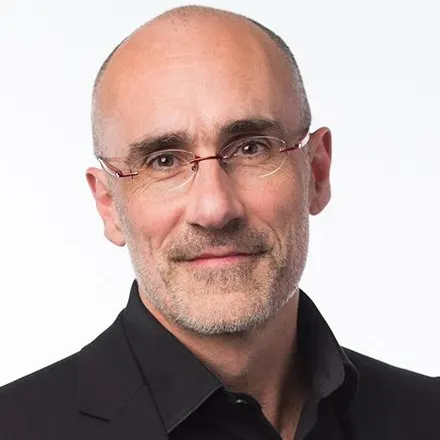
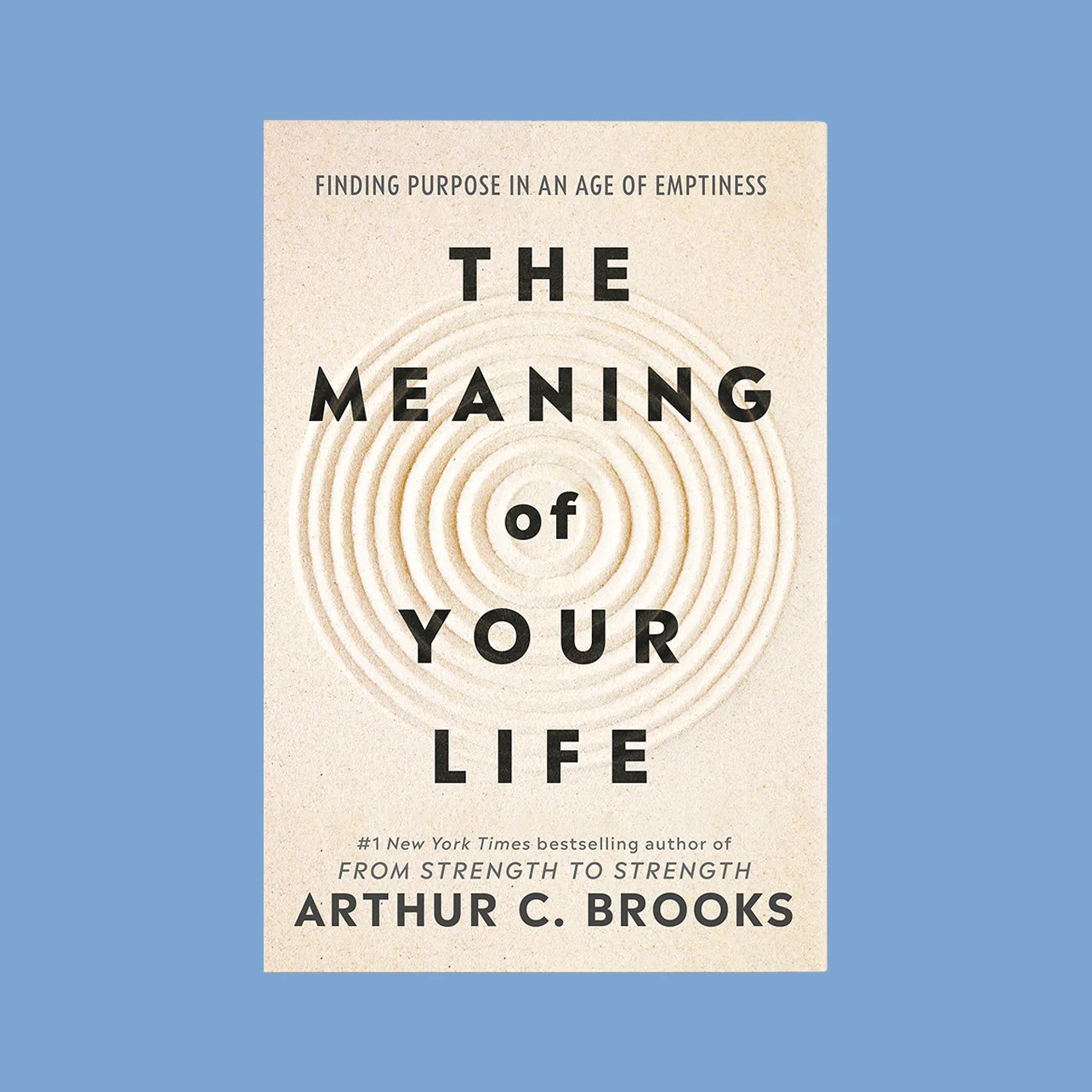
This excerpt was adapted from the book The Meaning of Your Life, written by Arthur C. Brooks. Penguin Random House, March 2026.
By outward appearances, Leo Tolstoy’s life’s what and how were ideal: he had money, fame, and worldly success. But inside, he was dying, unable to answer the why questions of his life.
While Tolstoy worked through this predicament in his own life, he was also working through it in the life of a character named Konstantin Levin in Anna Karenina, the novel he was working on at the time. Levin was a wealthy landowner who, like Tolstoy himself, had a near-perfect life on paper. He had a family and plenty of money and was respected by all those around him. But none of this satisfied his inability to understand the meaning of his life, which got worse and worse the more he analyzed and agonized about it, to the point that he was “stricken with horror, not so much of death, as of life."
The meaning of Levin’s life was, it turned out, the goodness he brought to it through the ordinary love he gave and received by living an ordinary life.
"He was in the position of a man seeking food in toy shops,” writes Tolstoy.
In desperation, Levin finally gave up his frantic, worldly search and, as a last resort, turned simply to living his ordinary life day to day. He focused on his wife and children. He cared for the people who worked for him. He focused intently on his work. And rather than wrestling with esoteric religious dilemmas, he let all his doubts go free and turned to a simple, transcendent faith in the divine, declaring, “To me individually, to my heart has been revealed a knowledge beyond all doubt, and unattainable by reason.”
And Levin found, to his surprise, that he finally understood the meaning of his life. The very last line of the entire novel is Levin’s realization of this truth: “My life now, my whole life apart from anything that can happen to me, every minute of it is no more meaningless. . . . [It] has the positive meaning of goodness, which I have the power to put into it.”
Ordinary life is no longer ordinary
The meaning of Levin’s life was, it turned out, the goodness he brought to it through the ordinary love he gave and received by living an ordinary life. If this were the year 1878, you could follow his example and just live a fairly ordinary life to find meaning, too, unless you inhabited the rarefied world of tortured intellectuals, philosophers, and scientists—the few who made their world on the left side of their brains.
You, too, would find life’s meaning by just relaxing into the normality of love, work, faith, beauty, and inevitable suffering. That would put you into your right hemisphere of your brain a lot of the time—the side of the brain where meaning, love, and mystery reside.
But this isn’t 1878, and ordinary life is no longer a simple life of love, care for others, work, and faith. “Ordinary life” today is just the opposite: it is a bundle of tech-laden distractions, complicated tasks that crowd out complex challenges, and—especially for strivers—a manic focus on achievement in comparison with the entire world all at once. Ordinary life today is, at best, a simulation of ordinary life in previous times. It leaves you, in Tolstoy’s formulation, starving inside a toy store.
That’s why I share the life experiences that were once taken for granted but no longer are: asking questions that can’t be googled, falling in love, seeking the divine, experiencing a sense of calling, immersing yourself in beauty, and embracing inevitable suffering. In doing these things, it’s not that you will invent your life’s meaning. Rather, you will reside in your brain’s right hemisphere long enough that you can find your life’s meaning.
But I am saying that the times before the tech simulation we live in today were far healthier when it came to living a harmonious interior life.
Am I asking you to turn back the clock to make your life more like the way your grandparents lived? Not in every way, obviously—I’m not suggesting that you shun antibiotics and smoke a pack of cigarettes every day. Nor am I asking you to try to live without technology or devices, which would be basically impossible. But I am saying that the times before the tech simulation we live in today were far healthier when it came to living a harmonious interior life.
It’s not your fault that ordinary life changed. But that doesn’t change the fact that what was once automatic behavior now is something you must adopt consciously. Some new rules must be applied to daily living. Here’s a place to start:
If any technology substitutes for in-person experiences, it should be used with extreme caution, like a dangerous and addictive drug.
If something makes you focus on yourself instead of others, shun it immediately. It is poison.
If you are afraid of love in real life, it means you need to take more risks with your heart.
If the material world is crowding out your sense of the supernatural, rebalance your time and priorities.
If your work is not a calling, no matter what it pays, start plotting your exit.
If beauty is missing from your life, go outside in nature immediately. Without your phone.
In the morning, as you start your day, say to yourself in the mirror, "The trials I face this day are evidence that I am living my life to the fullest.”
Will you fail? Yes, of course—a lot. And I will, too. But you will be pointed in the right direction for progress toward the ancient ways that led to eternal truths.
From The Meaning of Your Life by Arthur C. Brooks published on March 31, 2026 by Penguin Publishing Group, a division of Penguin Random House LLC. Copyright © 2026 by Arthur C. Brooks.