
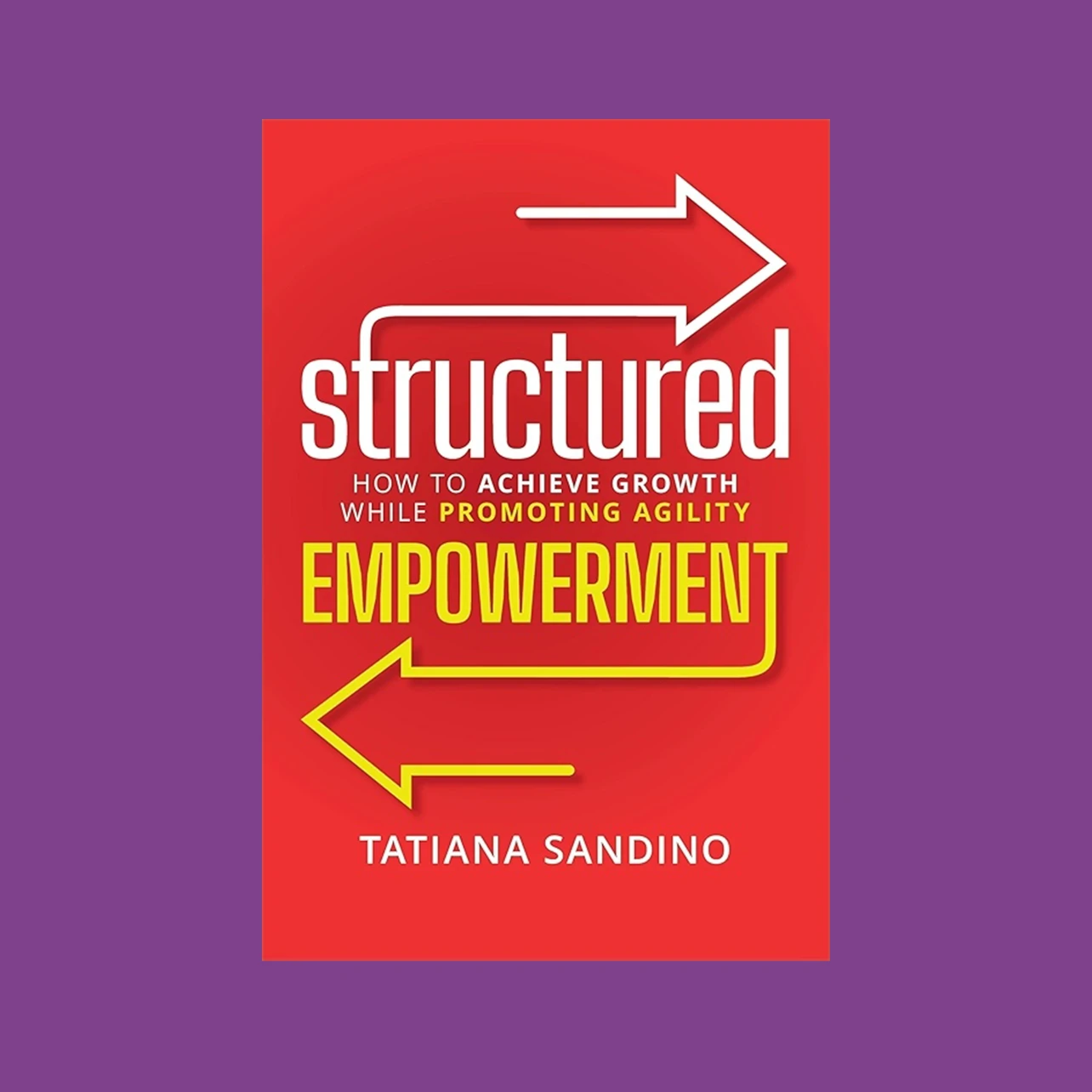
This excerpt was adapted from the book Structured Empowerment: How to Achieve Growth While Promoting Agility by Tatiana Sandino. John Wiley & Sons, Inc., March 2026.
Studies have shown that companies with purpose-driven cultures outperform peers. A strong culture makes the purpose clear and actionable for employees, fostering coordination and commitment. This, in turn, motivates them to improve customer satisfaction, boost sales, and deliver financial returns over time.
A strong culture makes the purpose clear and actionable for employees, fostering coordination and commitment.
However, a strong culture alone won’t keep companies agile. Scholars and practitioners warn that excessive cultural consensus—a culture where people predominantly agree on social norms—can stifle critical thinking and responsiveness. This is a particularly significant risk for fast-growing ventures or organizations operating in dynamic environments.
Consider one retailer I studied. Despite possessing a strong culture that emphasized promoting fun and courtesy, it inadvertently discouraged divergent views and negative feedback. Problems went unaddressed. An information technology (IT) engineer told me he and his peers could only discover software problems by going out in the field, because store employees worked around the bugs rather than demanding better IT. In other words, coworkers compensated for the underperformance of their peers. The retailer had cultivated a culture that, unintentionally, eschewed candid feedback. And without feedback, you can’t improve and adapt.
I refer to this as an empowering culture, which has three qualities:
Purpose-driven. Employees take ownership of the corporate purpose, actively collaborating to pursue it beyond their immediate responsibilities and the results they’re personally accountable for.
Adaptable, with an obsession to learn. Employees are encouraged to continuously improve their work by experimenting, taking appropriate risks, and innovating in response to evolving customer needs.
Psychologically safe. Employees feel safe to raise concerns, propose new ideas, and challenge the status quo.
High-performing, strong cultures typically emphasize a few core values. While some companies may prioritize values such as efficiency and compliance with safety standards, an empowering culture encourages adaptability and psychological safety. Employees are expected to adjust in response to evolving customer demands and organizational shifts—and can do so without fearing negative consequences.
Leaders who embrace these values drive organizational changes that respond to dynamic markets, which is especially critical for fast-growing ventures.
Leaders who embrace these values drive organizational changes that respond to dynamic markets, which is especially critical for fast-growing ventures. By contrast, a culture that is rule-bound and rigid is unlikely to foster the flexibility that empowerment and learning require.
The Mexican convenience store chain OXXO illustrates how a company can scale while preserving adaptability. Despite expanding to tens of thousands of stores, OXXO remained agile by encouraging critical thinking and inviting employees across the company to share new ideas. Everyone could civilly comment and respectfully disagree. CEO Eduardo Padilla described the ideal company culture as resembling a family:
“You may argue with your brothers and sisters, you may disagree with them, but you have these discussions because you care about one another.” This culture of openness, candor, and respect was not just lip service at OXXO—the company created open forums where employees could not only resolve problems but also put forward ideas for change. For example, as mentioned previously, every year there was a three-month “open season” during which all employees could suggest improvements to the company’s operating system, which yielded more than 800 ideas (and responses to each idea) annually.
The company also established a system that enabled employees to track and report problems, thereby encouraging adaptation to changing circumstances. When the employees noticed, for example, that a sign in their store was broken, they could file an inquiry using a software program.
The system would keep the issue flagged until it had been resolved to a leader’s satisfaction, enabling headquarters to track whether problems were addressed. At OXXO, this kind of direct, candid reporting was seen not as blaming but as an indication of care for one’s coworkers and the organization. It was in everyone’s interest to have a sign that worked.
In sum, an empowering culture is one that is clear and purpose-driven, where psychological safety allows people to feel comfortable offering ideas and feedback, and where employees are encouraged to adapt to market conditions and learn the best way to operate. This kind of culture complements the structured empowerment approach.
Excerpted with permission from the publisher, Wiley, from Structured Empowerment: How to Achieve Growth While Promoting Agility by Tatiana Sandino. Copyright © 2026 by John Wiley & Sons, Inc. All rights reserved. This book is available wherever books and eBooks are sold.