
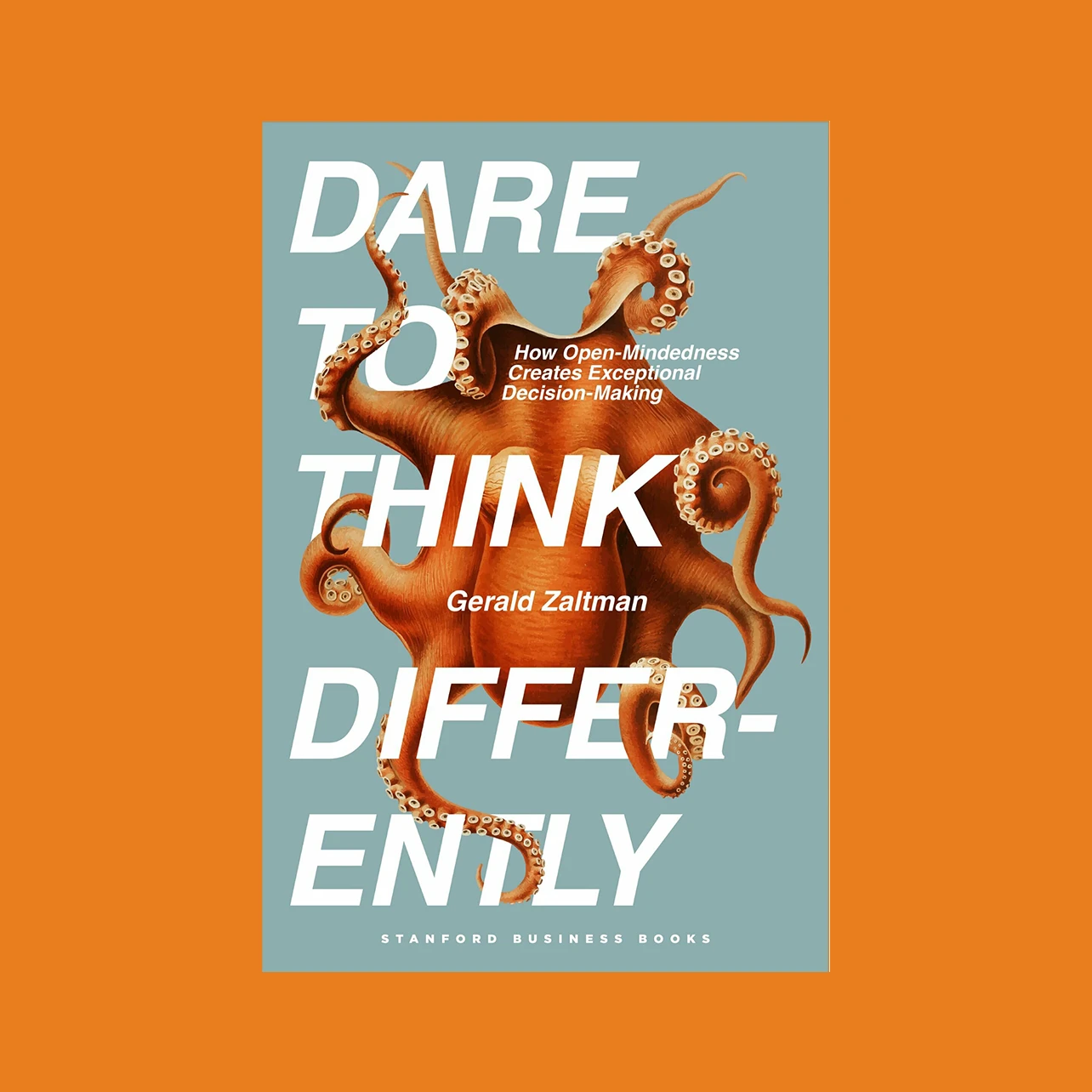
This is an excerpt from the book Dare to Think Differently: How Open-Mindedness Creates Exceptional Decision-Making by Gerald Zaltman. Stanford Business Books, February 2026.
Playful ignorance is often a partnership or a joint venture between discovery and invention, that is, between finding ideas that already exist but have previously escaped our attention, and ideas that are new. Sometimes one partner will be more prominent, sometimes the other. Both discovery and invention walk along the four paths of knowing: intuition, imagination, reasoning, and scientific procedures.
Many of the most successful decision-makers I’ve been privileged to know insist on seeking out and befriending important unknowns, an approach that is much less prevalent among their less successful colleagues.
Asking and answering various what-if questions, sometimes called “miracle questions,” can be like twisting a kaleidoscope—each turn produces a dramatically different view, helping transform sound strategies into excellent ones and converting failed solutions into ones that work. Here is a starter set of what-if questions:
What if the cause of the problem is multiple rather than singular (or vice versa)?
This approach often surfaces previously unobserved causes and even manifestations of a problem, correcting for what is sometimes called a Type III Error, which is solving the wrong problem.
What if our approach is too particularistic—or too generalizing?
For example, what if we view a market as having more or less segments than it really does? The tendency to carve markets up into increasingly finely differentiated segments can be costly. Why not try to hit a home run instead by focusing on the single most important need they all share? When resources are scarce, this type of triage is especially beneficial. If markets are segmented by age or ethnicity, for example, we may fail to recognize that each segment’s purchases are driven by the same emotional experience and readily addressed by the same product feature. Or, the opposite may be true, and we may be treating groups who want our service or product to do very different jobs for them as if they were the same.
What if we’ve reversed cause and effect?
A recent article on jet lag confidently asserted that simply thinking about being jet lagged in advance of a trip greatly worsened the jet lag the passenger ultimately experienced. But the methodology it used was fatally flawed, as it did not take into consideration the fact that some people have a greater biological susceptibility to jet lag than others. People with that susceptibility naturally think about jet lag with dread prior to a journey, while people who experience it rarely or never don’t. The results are the same, but the cause and the effect are the reverse of what the article suggested.
What if our evaluation is incorrect?
What if something we have judged to be bad is actually good? For generations, federal prohibitions against medically supervised experimentation with psychedelics were justified because of the potential for abuse. Now psychedelics are proving useful for treating such mental disorders as posttraumatic stress, depression, and alcohol dependency. The risk of abuse is far outweighed by the potential benefits.
Other what-if questions could address tools, metrics, research methodologies, evidence, and bias.
Epiphanies
“Aha!,” “I’ve got it!,” “Now I see!,” and the classic, “Eureka!” are expressions that suggest an epiphany has occurred. But what exactly has happened? Sometimes, a remembered piece of relevant information has bubbled up from the subconscious. Its arrival “out of the blue” suggests a magical, extraterrestrial, even heavenly source. An executive friend of mine once described such insights as “a collapse of vectors into knowing.”
Sometimes, its source is the imagination. Many of the best managers, researchers, and other professionals I’ve interviewed read between the lines of the incomplete data they have and imagine what else must be present for it to make sense. A chief marketing officer described the result of such an exercise:
[The answer] was clear as day. It didn’t have numbers attached... it wasn’t found in a transcript... but [it] reeked of truth. Once the idea was floated, everyone saw how all of our data supported it... As soon as I asked [the question], all the pieces of a very big puzzle fell into place. We all knew the answer was right.
Epiphanies never occur in a vacuum—ignorance doesn’t spontaneously turn into knowing, even when it feels that way. More likely there was a known piece of information that had been ignored up until the moment of insight. Whatever the case, epiphanies only happen to minds that welcome them.
Excerpted from Dare to Think Differently: How Open-Mindedness Creates Exceptional Decision-Making by Gerald Zaltman, published by Stanford Business Books, ©2026 by Gerald Zaltman. All Rights Reserved.